
If you’ve started exploring tankless water heaters, you’ve likely come across the Rinnai brand and two main types: condensing and non-condensing. This choice can feel overwhelming—especially with technical terms, efficiency ratings, and price differences. But understanding these two types is crucial if you want to pick the right model for your home, budget, and long-term comfort.
This article will guide you through everything you need to know about Rinnai tankless water heater condensing vs non condensing models. We’ll cover how each works, the main differences, real-world performance, energy costs, installation factors, and hidden details most homeowners overlook. By the end, you’ll feel confident to choose the right Rinnai tankless water heater for your needs.
How Tankless Water Heaters Work
Before we compare condensing and non-condensing models, it helps to understand how tankless water heaters function. Unlike traditional units with a big tank, tankless heaters only heat water when you turn on the tap. Water flows through a heat exchanger—this is where the gas burner or electric element heats the water instantly.
This on-demand heating means you never run out of hot water. It also saves energy, because you’re not keeping a large tank of water hot all day and night.
What Makes Rinnai A Top Choice?
Rinnai is one of the world’s leading brands for tankless water heaters. Founded in Japan, Rinnai has over a century of experience and a strong reputation for quality and innovation. Their models are known for:
- High reliability
- Advanced technology
- Long warranties
- Wide range of sizes
Many plumbers and homeowners trust Rinnai for both new installations and replacements. The company offers models for small apartments up to large homes with multiple bathrooms.
Condensing Vs Non-condensing: The Big Picture
The main difference between condensing and non-condensing tankless water heaters is how they handle heat and exhaust gases.
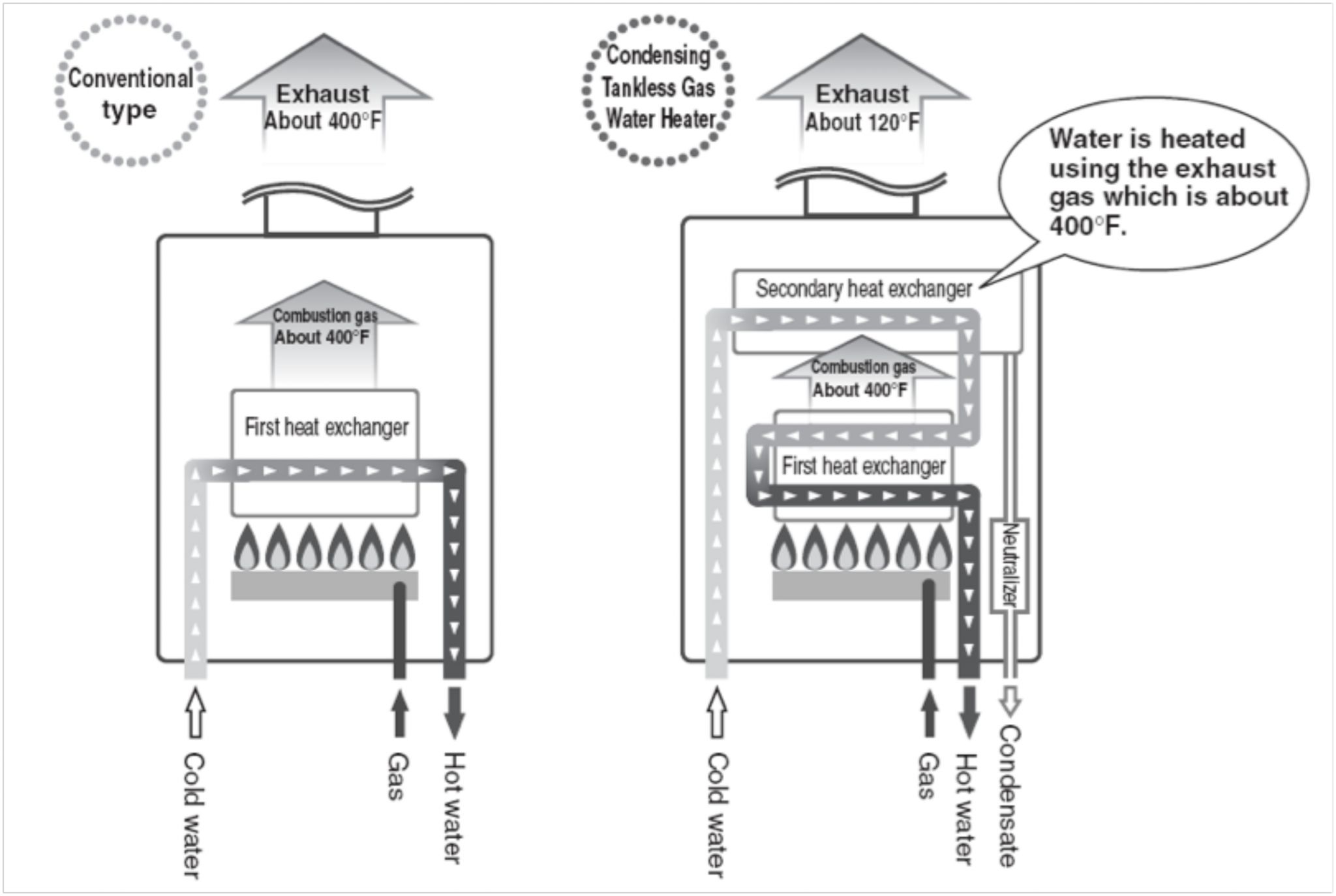
- Non-condensing models use a single heat exchanger. They heat water quickly, but a lot of heat escapes in the exhaust gases—this means lower energy efficiency.
- Condensing models have a second heat exchanger. They capture extra heat from the exhaust, using it to warm the water. This makes them more efficient and cooler to vent.
This difference affects energy costs, venting requirements, installation, maintenance, and long-term value. Let’s go deeper into how each type works.
How Non-condensing Rinnai Tankless Water Heaters Work
Non-condensing Rinnai models heat water using a single heat exchanger. When you open a hot water tap:
- Cold water enters the unit.
- The gas burner turns on, heating the water as it passes through the heat exchanger.
- Hot water flows out to your shower or faucet.
- Hot exhaust gases (up to 300°F/150°C) leave through a metal vent.
These models are simple and fast. However, much of the energy is lost as hot gases are vented outside. This reduces their overall efficiency.
How Condensing Rinnai Tankless Water Heaters Work
Condensing Rinnai models use two heat exchangers. Here’s the process:
- Cold water enters the primary heat exchanger.
- The gas burner heats the water.
- Before the exhaust gases leave, they pass through a secondary heat exchanger.
- This second exchanger captures more heat, using it to pre-warm incoming cold water.
- The now cooler exhaust gases (under 120°F/50°C) are vented out—usually through plastic pipes.
The result is higher energy efficiency and lower exhaust temperatures. However, condensation forms as the exhaust cools, which must be drained safely.
Key Differences: Condensing Vs Non-condensing Rinnai
Let’s break down the main differences between these two types of Rinnai tankless water heaters.
| Feature | Condensing | Non-Condensing |
|---|---|---|
| Heat Exchanger | Two (primary + secondary) | One (primary only) |
| Efficiency (UEF) | Up to 0.95 | 0.80–0.82 |
| Exhaust Temp | Low (plastic vent OK) | High (metal vent required) |
| Condensate Drain | Yes, required | No |
| Upfront Cost | Higher | Lower |
| Installation Cost | Can be higher | Usually lower |
Credit: www.woolyyarn.com
Energy Efficiency And Operating Costs
Condensing Rinnai models are more efficient. They use up to 97% of the gas energy (Uniform Energy Factor/UEF up to 0.95). Non-condensing models are usually around 80–82% efficient (UEF 0.80–0.82).
What does this mean for you? Let’s use an example.
- If you spend $500 a year on hot water with a non-condensing unit (82% efficient), upgrading to a condensing model (95% efficient) could save about $70–$85 each year.
- Over 10 years, that’s $700–$850 in savings.
For larger families or heavy hot water use, the difference is even bigger. But the true savings depend on your local gas prices and how much hot water you use.
Environmental Impact
Condensing units waste less energy and release cooler exhaust. This means less greenhouse gas is produced for the same amount of hot water. If you want a greener home, condensing is the better choice.
Some cities or states even offer rebates for high-efficiency water heaters. Check your local utility for possible incentives.
Installation: What Changes?
Venting Requirements
- Non-condensing models vent very hot gases. This requires stainless steel or metal vent pipes that can handle high temperatures.
- Condensing units vent cooler exhaust. You can use PVC or polypropylene pipes. These are cheaper and easier to install, especially in retrofits or long vent runs.
Condensate Drain
Condensing models produce water as a byproduct (condensate). This must be drained into a floor drain or condensate pump. Some homes need extra plumbing for this, which can add to installation costs.
Placement Flexibility
Cooler exhaust means condensing units can be installed in more places, sometimes closer to bathrooms or kitchens. This can reduce hot water delay (“cold water sandwich” effect).
Upfront And Long-term Costs
Equipment Cost
- Non-condensing Rinnai units are usually $700–$1,200.
- Condensing Rinnai units run $1,200–$2,500, depending on size and features.
Installation Cost
- Non-condensing: Usually $1,000–$2,000 (depends on venting distance and labor).
- Condensing: $1,200–$2,500. May be higher if you need a condensate drain or long vent runs.
Maintenance
Condensing models need condensate drains checked for blockages. Both types need annual descaling if you have hard water. Some users forget to clean the intake air filter—this can cause performance drops.
Lifetime Cost
A condensing model may cost more upfront but can save hundreds or thousands over its life, especially with high hot water use.
Real-world Performance
Hot Water Output
Both types deliver endless hot water. Rinnai models are sized by gallons per minute (GPM)—a typical family home needs 7–10 GPM for two showers and a dishwasher running at once.
Choose the right size for your needs, not just the most powerful unit. Oversizing wastes money.
Cold Water Sandwich
Both types can have a brief burst of cold water if you use hot water, shut it off, then turn it on again quickly. This is normal for tankless systems. Some condensing models recover faster due to their design.
Noise
Condensing models may be slightly quieter because exhaust fans run at lower speeds. Both types are much quieter than most tank water heaters.
Durability And Lifespan
Rinnai tankless water heaters are built to last. With proper maintenance, both condensing and non-condensing units can run for 15–20 years.
- Condensing models have more parts (second heat exchanger, condensate drain), so there’s a bit more to maintain.
- Rinnai offers long warranties—often 10–12 years on the heat exchanger and 5 years on parts.
One non-obvious tip: Soft water extends the life of any tankless heater. Hard water can cause mineral buildup, especially in the heat exchangers.
Home Size And Hot Water Needs
Which type fits your home? Here’s a simple guide:
- Condensing: Best for large homes, high hot water use, or new construction. Also good if you want lower gas bills or qualify for energy rebates.
- Non-condensing: Fits smaller homes, lower hot water demand, or tighter budgets. Good for replacing old tank units where venting is already set up.
Examples Of Popular Rinnai Models
Let’s look at two real Rinnai models—one condensing, one non-condensing.
Rinnai Ru199in (condensing)
- Up to 11 GPM (enough for 3 showers at once)
- 0.93 UEF efficiency
- Indoor installation
- Requires PVC vent and condensate drain
- Wi-Fi compatible
- Price: Around $1,800–$2,200
Rinnai V75in (non-condensing)
- Up to 7.5 GPM (2 showers at once)
- 0.82 UEF efficiency
- Indoor installation
- Requires metal vent
- Simple controls
- Price: Around $900–$1,300
Both models are reliable and backed by Rinnai’s warranty. The RU199iN costs more, but saves more energy and handles bigger homes.
Choosing The Right Model: What Really Matters
When comparing condensing vs non-condensing Rinnai models, keep these factors in mind:
- Upfront budget—How much can you invest now?
- Hot water demand—How many showers, tubs, or appliances run at once?
- Energy bills—Do you want the lowest long-term cost?
- Home layout—Is venting easy to install? Is a drain nearby for condensate?
- Climate—Colder areas need higher GPM models.
- Rebates—Are efficiency incentives available?
Don’t just focus on the purchase price. Consider installation, energy savings, and maintenance over the lifetime of the unit.
Common Buyer Mistakes To Avoid
- Ignoring venting needs: Don’t assume your old vent will work. Condensing units use plastic vents and need condensate drains.
- Oversizing: Bigger is not always better. An oversized heater costs more and may cycle on/off too often.
- Skipping maintenance: Annual flushing is essential, especially with hard water.
- Forgetting about rebates: Many areas offer cash back for condensing (high-efficiency) models.
- Not checking water quality: Hard water shortens heater life. Consider a water softener if needed.
Practical Tips For Installation And Use
- Always use a licensed plumber for installation. Rinnai warranties require professional setup.
- If switching from a tank to tankless, plan for new venting and possible gas line upgrades.
- Install a recirculation pump if you want instant hot water at distant taps.
- Clean the air intake filter every 6–12 months for best performance.
- Check the condensate drain for blockages every year (condensing only).
Warranty And Support
Rinnai offers some of the best warranties in the business. Most condensing and non-condensing models have:
- 10–12 years on the heat exchanger
- 5 years on parts
- 1 year on labor (professional install required)
Rinnai also has strong customer support and a large network of certified technicians in the US.
Real User Experiences
Many homeowners report lower gas bills and endless hot water after switching to a Rinnai tankless heater. Plumbers often recommend condensing models for new homes or heavy use, while non-condensing is popular for budget-friendly upgrades.
Some users note that the learning curve is real—tankless heaters need regular maintenance, and the initial cost can feel high. But most agree the long-term comfort and savings are worth it.
Detailed Side-by-side Comparison
Here’s another look at the key specs:
| Specification | Condensing | Non-Condensing |
|---|---|---|
| Uniform Energy Factor (UEF) | 0.90–0.95 | 0.80–0.82 |
| Venting Material | PVC/Polypropylene | Stainless steel/Metal |
| Condensate Drain | Required | Not needed |
| Installation Flexibility | More options | May be limited by venting |
| Upfront Cost | Higher | Lower |
| Maintenance Needs | Annual flush + drain check | Annual flush |
| Expected Lifespan | 15–20 years | 15–20 years |

Credit: stogagirlssoccer.com
Popular Rinnai Series: Which To Consider
Rinnai offers several product series for both condensing and non-condensing models. Here’s a quick overview:
- RU Series (Super High Efficiency): Condensing, best for large homes, high GPM, ENERGY STAR® certified.
- RL Series: Condensing, good for medium to large homes.
- V Series: Non-condensing, budget-friendly, great for smaller homes or apartments.
- RE Series: Non-condensing, compact, easy replacement for old tanks.
Each series comes in various sizes (measured in GPM). Always match the unit to your home’s maximum hot water demand, not just the number of bathrooms.
Should You Upgrade To Condensing?
If you’re building a new home, want the highest efficiency, or plan to stay in your home for 10+ years, a condensing Rinnai tankless water heater is usually the best investment. The energy savings, rebates, and installation flexibility often outweigh the higher upfront cost.
But if your budget is tight, your home can’t easily handle a condensate drain, or you’re replacing an old tank and want a quick swap, a non-condensing model will still deliver endless hot water and lower bills than a standard tank.

Credit: urgasa.com
Two Insights Most People Miss
- Venting can be a deal-breaker. Many older homes can’t easily add a condensate drain, which is a must for condensing models. Always check your home’s plumbing and vent routes before you buy.
- Water hardness matters. Hard water builds up faster in condensing models due to the extra heat exchanger. A simple in-line filter or water softener can double the life of your heater.
Where To Learn More
If you want technical details or rebate info, the official Rinnai website has specs, manuals, and sizing tools.
Frequently Asked Questions
What Is The Main Difference Between Rinnai Condensing And Non-condensing Tankless Water Heaters?
The main difference is energy efficiency. Condensing models use a second heat exchanger to recover extra heat from exhaust gases, making them up to 15% more efficient. Non-condensing models have only one heat exchanger, so more heat is lost in the exhaust.
Which Is Cheaper To Install, Condensing Or Non-condensing?
Non-condensing models are usually cheaper to install because they don’t require a condensate drain. However, their metal vent pipes can cost more than the plastic pipes used in condensing installations. The total cost depends on your home’s layout.
Do Condensing Tankless Water Heaters Need More Maintenance?
Condensing units need annual maintenance just like non-condensing units. The main extra step is checking and cleaning the condensate drain line. Both types benefit from yearly descaling, especially in hard water areas.
Can I Replace My Old Water Heater With A Rinnai Tankless Unit?
Yes. Most homes can upgrade to a Rinnai tankless water heater. You may need to update venting, gas lines, or add a condensate drain for condensing models. A licensed plumber can assess and handle the installation.
How Long Does A Rinnai Tankless Water Heater Last?
With proper maintenance, both condensing and non-condensing Rinnai models can last 15–20 years. Regular flushing and cleaning the air intake filter help ensure a long life.
Final Thoughts
Choosing between a Rinnai condensing vs non-condensing tankless water heater comes down to your budget, hot water needs, and home setup. Condensing models offer higher efficiency, lower energy bills, and are more eco-friendly, but cost more upfront and may require new venting or drains. Non-condensing models are budget-friendly and easier to install in many older homes, but miss out on some energy savings.
Take time to assess your home, compare installation options, and think about long-term savings. Whether you pick condensing or non-condensing, a Rinnai tankless water heater is a major upgrade in comfort, reliability, and peace of mind.