
Propeller pitch sets thrust per turn; RPM sets how fast the turns happen.
If you’ve ever wondered why a boat or airplane feels strong off the line but struggles at top speed, or why your engine misses its target range, the answer often sits in the balance of propeller pitch vs rpm. I’ve tuned props on small outboards and flown fixed-pitch aircraft in hot-and-high air, and the same rule holds: match propeller pitch vs rpm to the engine’s sweet spot, and performance, fuel burn, and reliability all improve. In this guide, we’ll break down propeller pitch vs rpm with simple terms, real tests, and steps you can follow today.
What Propeller Pitch And RPM Mean
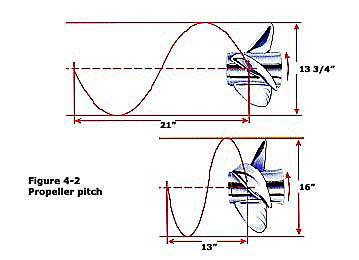
Think of pitch as the “gear” cut into the prop. A 19-inch pitch prop tries to move 19 inches forward each turn in a perfect, no-slip world. RPM is how many turns happen each minute.
Engines make torque and power best in a certain RPM band. A prop with more pitch loads the engine more. RPM drops. A prop with less pitch loads the engine less. RPM rises.
There is always some slip. Water and air are not solid. Slip is the gap between the ideal distance per turn and what you get in real life. It grows with heavy load, rough water, high drag, or low speed.
How Propeller Pitch vs RPM Interact
The link is simple. Pitch changes how far you move each turn. RPM changes how many turns you get. Together, they set thrust, speed, and engine load.
Here is how they play out:
- Raise pitch. Lower RPM at the same throttle. Higher possible top speed if the engine can pull it. Risk of lugging the engine.
- Lower pitch. Raise RPM at the same throttle. Better hole shot or climb. Lower top speed if you hit the RPM limit.
- Stay in the maker’s wide-open throttle (WOT) range. That is where power and cooling work best.
Boat example:
- Your outboard’s WOT range is 5000–6000 RPM. You see 6400 RPM at WOT with a light load. Move up 1 inch of pitch. Expect about 150–200 RPM drop. Target the middle of the range with your normal load.
Aircraft example:
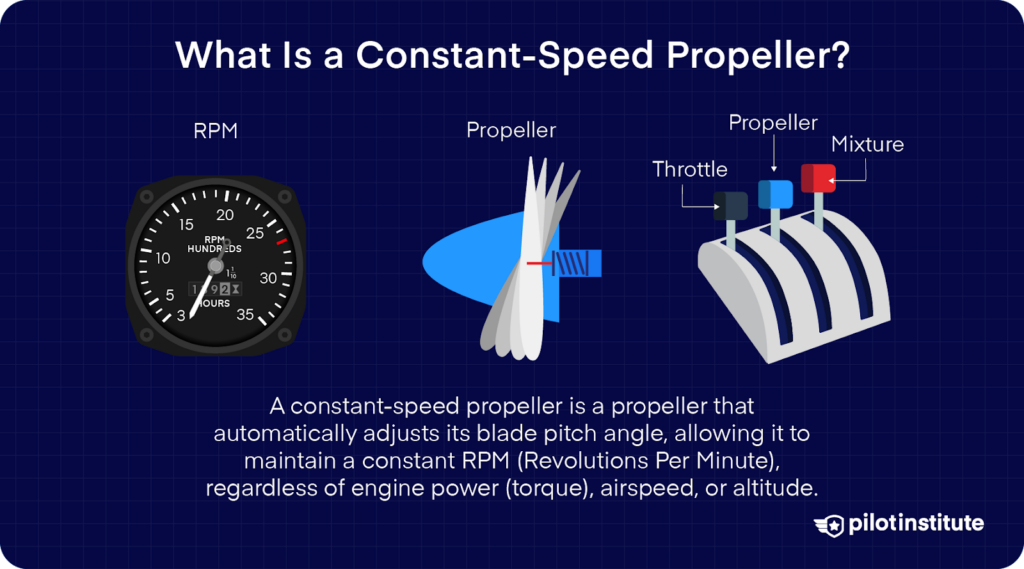
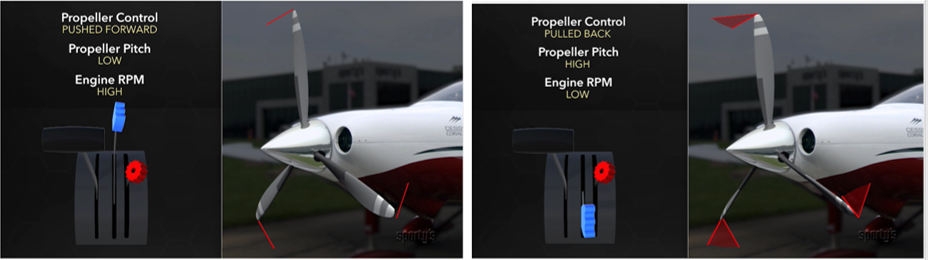
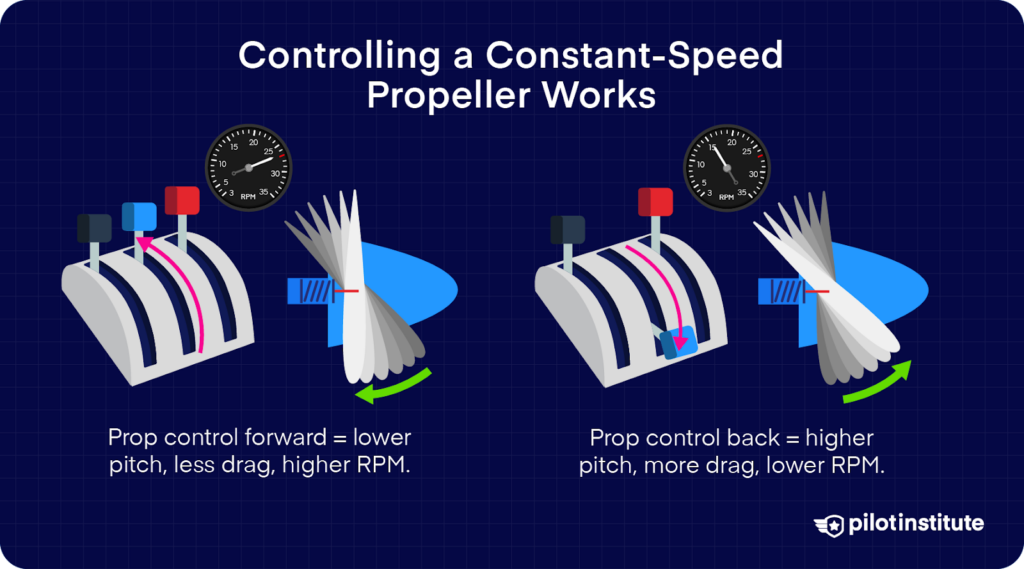
- A climb prop has lower pitch. It lets the engine spin near rated RPM on takeoff. A cruise prop has higher pitch. It lowers RPM at the same throttle in cruise. With a constant-speed prop, you set RPM and the governor adjusts pitch to hold it.

Effects On Performance Of Propeller Pitch vs RPM
Your choice of propeller pitch vs rpm shapes how the machine feels and lasts.
Speed and acceleration:
- Lower pitch helps you jump on plane or climb faster.
- Higher pitch can increase top speed, but only if the engine can reach rated RPM.
Fuel burn and range:
- Engines are most efficient near peak torque and proper mixture. Hitting target RPM at common speeds helps you save fuel.
Engine health:
- Over-rev hurts parts and can hit a limiter.
- Lugging (low RPM, high throttle) raises heat and stress. It can shorten engine life.
Handling, noise, and comfort:
- Too much pitch at low speed can cause slow response.
- Over-rev can be loud and rough.
Cavitation and ventilation:
- If blades see too much angle or poor flow, they can cavitate. That cuts thrust and can pit blades.
- Ventilation is when air or exhaust gets to the blades. It also reduces bite.
Picking The Right Prop For Boats
Start with the maker’s WOT range. For many outboards, that is 5000–6000 RPM. For many inboards, 4200–4800 RPM. Aim for mid to high in the range with your normal load.
Steps I use in sea trials:
- Set a baseline. Clean the hull. Check the prop for dings. Use fresh fuel. Note gear ratio and prop size.
- Run WOT with your usual crew and gear. Record RPM and GPS speed in calm water.
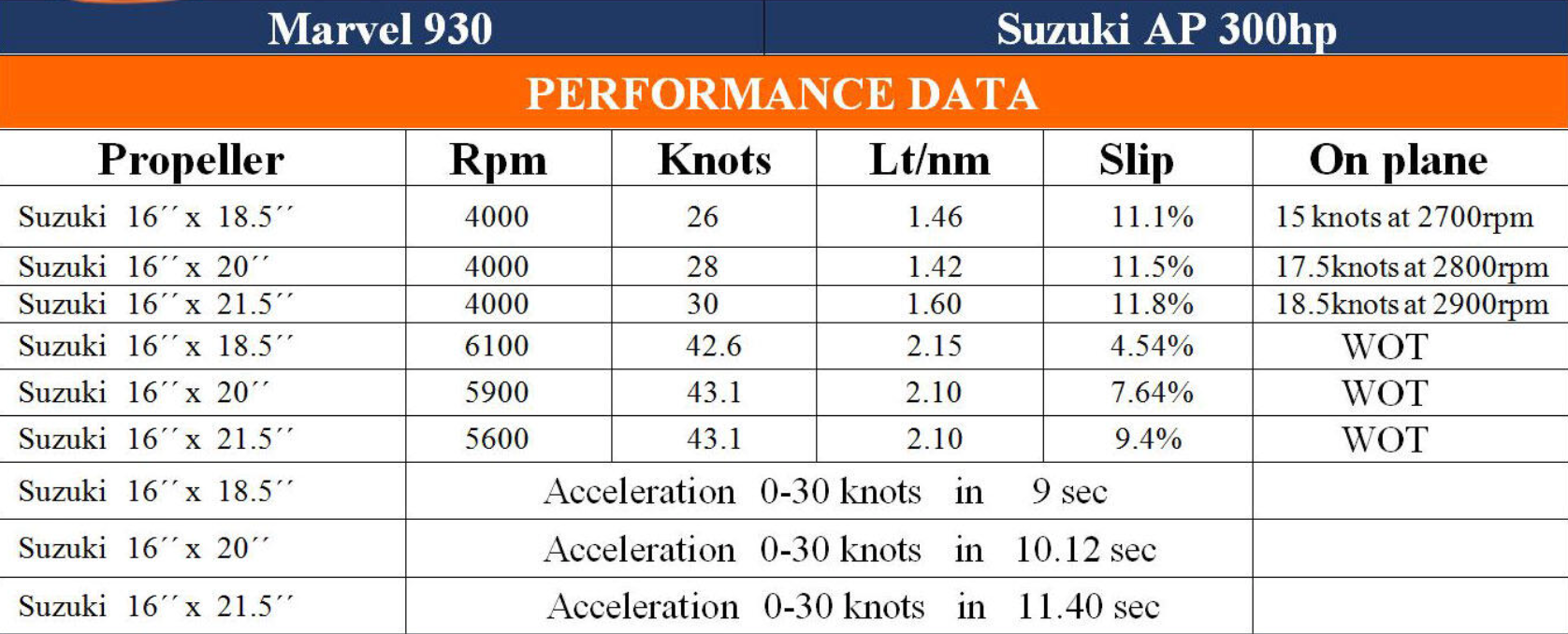
- Adjust pitch by 1 inch at a time. Expect about 150–200 RPM change per inch on many setups.
- Keep diameter as large as you can without overloading. If you add pitch, you may drop diameter a touch to balance load.
- Consider cupping. A cupped prop can hold water better, reduce slip, and drop RPM slightly.
- Re-test in the same spot and trim.
Real-world tip:
- I set up a 115 hp outboard that over-revved at 6200 RPM with a 17-pitch prop. A 19-pitch dropped WOT to 5850 RPM. Top speed rose 2 mph. Hole shot stayed fine with a bit of trim-in and a cupped blade.

Choosing Propeller Pitch vs RPM In Airplanes
Fixed-pitch props:
- Climb prop. Lower pitch. Strong takeoff and climb. Higher RPM in cruise. More noise.
- Cruise prop. Higher pitch. Lower RPM at a given speed. Better cruise. Longer takeoff roll.
Constant-speed props:
- You set RPM with the prop control. The governor changes pitch to hold that RPM.
- For takeoff, go full fine (low pitch, high RPM). For cruise, set a lower RPM and lean as approved.
Key checks:
- Follow the POH limits for max continuous RPM.
- Meet static RPM checks. If static RPM is too low, pitch may be too high. If too high, pitch may be too low.
- Do not change certified props or settings without the right approvals. Talk to your A&P or prop shop.
Hot-and-high note:
- At high density altitude, power drops. Lower pitch can help you reach target RPM and keep climb rate safer.
Measuring, Testing, And Tuning
Use simple tools and a clear plan.
- Tachometer. Trust a known-good tach or an optical unit to confirm RPM.
- GPS speed. Log speed both ways and average to cancel wind or current.
- Fuel flow or refill method. Track burn at set RPM.
- Load notes. Crew, fuel level, gear, water, air temp.
Quick slip check for boats:
- Theoretical speed (mph) ≈ (Pitch in inches × RPM × 60) ÷ (Gear ratio × 1056).
- Slip (%) ≈ 100 × (Theoretical − GPS) ÷ Theoretical.
- For planing hulls at speed, 5–15% slip is common. Much higher can mean a setup issue.
Flight test flow:
- For fixed-pitch, note static RPM, takeoff roll, climb RPM, and cruise RPM vs airspeed.
- For constant-speed, confirm the governor holds set RPM in climb and cruise.
Common Mistakes And Easy Fixes
Mistakes I see often:
- Chasing top speed and missing safe RPM. Fix: Hit the maker’s WOT band first.
- Ignoring gear ratio. Fix: Use the right math. Compare setups on equal terms.
- Trusting a bad tach. Fix: Verify with a second tool.
- Testing with a dirty hull or fouled prop. Fix: Clean before trials.
- Forgetting load and weather. Fix: Log conditions. Tune for your normal day.
- Over-trimming. Fix: Trim for clean bite. Watch for slip spikes.
- Running at low RPM and heavy throttle for long periods. Fix: Downshift in water terms. Use less pitch or less throttle.
Real-World Stories And Lessons
Small bay boat:
- My skiff struggled to plane with family and a cooler. The engine hit only 4600 RPM. Spec called for 5000–6000. I dropped from 19 to 17 pitch with light cupping. WOT rose to 5600. Time to plane fell by half. Cruise moved to the engine’s sweet spot. Fuel burn dropped.
Training aircraft:
- In summer heat, our fixed-pitch trainer could not hit target climb RPM. We swapped to a freshened, slightly lower-pitch prop per approved spec. Static RPM came back in range. Takeoff roll shortened. Cruise RPM rose a bit, but fuel planning was simple. The change felt like shifting to the right gear on a bike.
Lesson:
- The right propeller pitch vs rpm feels effortless. You do not fight the throttle. The machine breathes and moves with less strain.

Advanced Concepts That Shape Propeller Pitch vs RPM
Prop slip and efficiency:
- Some slip is normal. Less slip at cruise often means better efficiency.
- Cupping, rake, and blade area can reduce slip and hold water or air better.
Diameter and blade count:
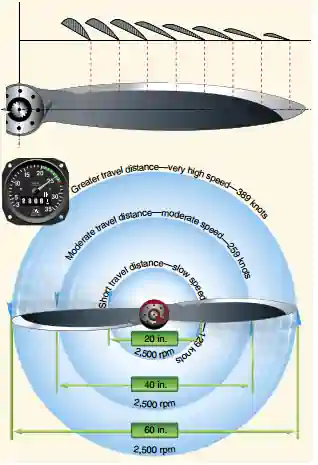
- Bigger diameter moves more fluid at lower RPM. It can boost thrust but may load the engine.
- More blades can smooth things and cut vibration. It may need less diameter or pitch to hold RPM.
Gear ratio:
- A lower gear ratio (numerically higher, like 2.0:1) spins the prop slower than the crank. It allows bigger diameter or more pitch while staying in safe RPM.
Hull or airframe drag curve:
- Every craft has a speed where drag rises fast. You want propeller pitch vs rpm to match the power curve where it counts.
Electric and diesel notes:
- Electric motors have strong torque at low RPM. They often run larger, lower-pitch props at modest RPM.
- Diesels prefer lower RPM and high torque. Prop to avoid lugging and to hold rated WOT under load.
Troubleshooting Quick Guide
If RPM is too high at WOT:
- Add 1 inch of pitch at a time. Consider more cup. Check for ventilation.
If RPM is too low at WOT:
- Drop 1 inch of pitch at a time. Clean the prop. Confirm you are not over-propped.
If speed is low but RPM is right:
- Check slip. Inspect hull, prop, and trim. Reduce drag. Verify gear ratio and tach.
If takeoff or hole shot is weak:
- Lower pitch. Add blade area or cup. Adjust trim. In planes, reduce weight and use performance takeoff technique.
If there is vibration or noise:
- Inspect blades for dings and balance. Try fewer blades or a different material. Re-check engine mounts.
Frequently Asked Questions of propeller pitch vs rpm
Is higher pitch always faster?
No. Higher pitch can raise top speed only if the engine still hits its rated RPM. If RPM drops too far, speed and efficiency fall.
How many RPM does 1 inch of pitch change on a boat?
On many setups, about 150–200 RPM per inch of pitch. Your exact change depends on gear ratio, slip, and load.
What is the best WOT RPM to target?
Aim for the maker’s WOT range with your normal load. Mid to upper range is a safe, efficient target for most boats and small engines.
How does a constant-speed prop change the game?
You set RPM and the governor adjusts pitch to hold it. That keeps the engine in the sweet spot while the prop changes bite as airspeed and load change.
Can cupping replace more pitch?
Cupping can lower RPM a bit and cut slip. It is not a full pitch swap but can fine-tune grip and midrange.
Does altitude affect propeller pitch vs rpm?
Yes. At higher density altitude, engines make less power and RPM may fall under load. A lower pitch can help recover target RPM.
What is prop slip and should I worry?
Slip is the loss between ideal and real advance per turn. Some slip is normal, but very high slip points to setup or condition issues.
Will more blades raise or lower RPM?
More blades add area and load, which can lower RPM. You may need less pitch or diameter to hold the same RPM.
Can I tune propeller pitch vs rpm for fuel savings?
Yes. Match RPM to the engine’s efficient band at your typical speed. Many see smoother running and lower fuel burn.
Is it safe to change prop pitch on a certified airplane?
Only within approved data and parts. Follow the POH and talk to an A&P or prop shop before any change.
Conclusion
Propeller pitch vs rpm is the art of picking the right gear for your engine and mission. Get it right and you feel clean pull, steady RPM, better range, and less stress on parts. Get it wrong and you fight noise, heat, and a sluggish ride.
Take one step today. Log your WOT RPM and GPS speed with your usual load. If you are outside the maker’s range, adjust pitch one step and re-test. Your boat or airplane will thank you.
Want more guides like this? Subscribe, share your test data in the comments, and tell me what you want to tune next.