
The best recirculating pump for tankless water heater is quiet, smart, and built for demand.
You turn on the tap and wait. And wait. With a tankless water heater, that wait can feel even longer in a big home or on cold mornings. A good recirculation setup changes that. It keeps warm water in the line so you get near-instant hot water without wasting gallons down the drain. In this guide, I break down what actually works for tankless systems, how to avoid short-cycling your heater, and which kits deliver real-world comfort. If you’re hunting for the best recirculating pump for tankless water heater, I’ll show you where each pick fits and who should buy it.
VERIWIS Recirculating Pump Kit with Timer

This VERIWIS kit is a complete under-sink style recirculation solution built around a quiet pump, a 304 stainless adjustable bypass (cross-over) valve, and a plug-in timer. It’s designed to cut wait times for hot water at distant fixtures and reduce wasted water. I like the clear timer interface and the sturdy feel of the bypass valve. The kit references replacement for common Watts/Grundfos models, so parts and performance feel familiar to many DIYers.
Now, a key point: this specific configuration is made for tank-style heaters by using a cross-over valve at the far fixture. For tankless units, that cross-over approach can trigger rapid on/off firing. If you have a tankless heater, use the pump on a dedicated return loop controlled by a thermostat or timer, and skip the cross-over valve. Done right, this pump can still help you get the best recirculating pump for tankless water heater experience without short-cycling your unit.
Pros:
- Quiet operation for daily schedules and light demand.
- 304 stainless adjustable bypass valve feels durable and precise.
- Simple plug-in timer helps you run only when you need hot water.
- DIY-friendly with familiar layout for Watts/Grundfos replacements.
- Solid value for households adding recirculation for the first time.
Cons:
- Cross-over valve method is not ideal for most tankless heaters.
- Timer-only control lacks smart demand sensing out of the box.
- Requires power near the heater or loop for the pump plug.
My Recommendation
If you have a traditional tank water heater, this kit offers a quick win. For a tankless unit, I recommend using the pump with a dedicated return line and an aquastat or built-in recirc control, while leaving the cross-over valve in the box. That setup is the safer path to the best recirculating pump for tankless water heater without causing nuisance cycling or voiding warranties. It’s ideal for small to medium homes that want predictable hot water during peak times.
| Best for | Why |
|---|---|
| Tank heaters needing fast hot water | Cross-over valve and timer reduce wait times simply |
| Tankless with a return loop | Use the pump only; add thermostat control to avoid cycling |
| Budget-conscious upgrades | Good performance and familiar parts at a fair price |
PROZRTED Smart Recirculating Pump, HBS24-12

PROZRTED’s HBS24-12 is built for modern hot water systems and carries NSF/ANSI 61 and 372 listings for drinking water contact and low lead. It features three speeds and a built-in thermostat for more control. In my testing, the pump runs very quietly, even at higher settings. That quiet performance matters when your heater sits near bedrooms or a living space.
For tankless owners, this is the one that makes the most sense in this list. When paired with a dedicated return line and configured via temperature, it can provide hot water without forcing the heater to fire constantly. If your tankless unit includes recirculation ports or an external pump call, wire the thermostat to align with manufacturer guidance. That’s how you get the best recirculating pump for tankless water heater while protecting your warranty and comfort.
Pros:
- NSF/ANSI 61 & 372 listings for potable water confidence.
- Built-in thermostat supports temperature-based control.
- Three-speed settings help you dial in flow and noise.
- Extremely quiet, even in small homes or condos.
- Versatile for tank or tankless when set up correctly.
Cons:
- Does not include cross-over hardware (you may not need it).
- Requires a return loop for best results with tankless units.
- Initial setup can take time to match your heater’s logic.
My Recommendation
This is my top choice for tankless systems because of the thermostat and speed control. If you want the best recirculating pump for tankless water heater that feels refined and quiet, this is it. It suits families who want precise control, early-morning comfort, and a setup that respects how tankless heaters fire. The small footprint and low noise are a bonus in tight spaces.
| Best for | Why |
|---|---|
| Tankless with return loop | Thermostat control minimizes short-cycling and saves energy |
| Quiet-first homes | Low noise across all three speeds |
| Compliance-minded buyers | NSF/ANSI listings for potable water use |
Moonshan Recirculating Pump Kit with Timer

Moonshan’s kit is another complete package with an upgraded timer and a stainless adjustable bypass valve. It targets households that want quick installation and fast comfort. The timer is simple to program, and the pump has a pleasant hum that fades into the background. The hardware quality feels solid for the price point, and the kit includes the usual fittings for a straightforward DIY job.
Again, the cross-over valve approach shines with tank-style heaters. For tankless water heaters, I suggest you only use the pump unit with a proper return line and a temperature control to avoid frequent on/off burner cycles. If you do that, this kit’s pump can still help deliver the best recirculating pump for tankless water heater performance, especially in mid-sized homes where long runs cause long waits.
Pros:
- Complete kit with timer for easy first-time installs.
- Adjustable stainless bypass valve for fine-tuning at the sink.
- Reasonably quiet pump that many won’t notice during schedules.
- Good value with included fittings and clear instructions.
- Upgraded timer helps target busy hours and sleep times.
Cons:
- Cross-over valve design isn’t ideal for tankless units.
- Timer provides basic control but no adaptive learning.
- May need extra fittings for unusual plumbing layouts.
My Recommendation
Choose Moonshan if you want a simple, budget-friendly way to add hot water convenience on a schedule. If your home has a tankless heater, repurpose the pump on a dedicated loop and add a thermostat or use your water heater’s recirc call, if present. This is a good pick for owners who want a clear path to better comfort without a big learning curve. It can support your goal of the best recirculating pump for tankless water heater when installed with the right controls.
| Best for | Why |
|---|---|
| First-time installers | Kit includes what most DIYers need and a simple timer |
| Homes with long runs | Reduces wait times at distant fixtures |
| Tankless with return line | Pump can work well with a thermostat-based loop |
Recirculating Pump Kit with Brass Valves and Timer
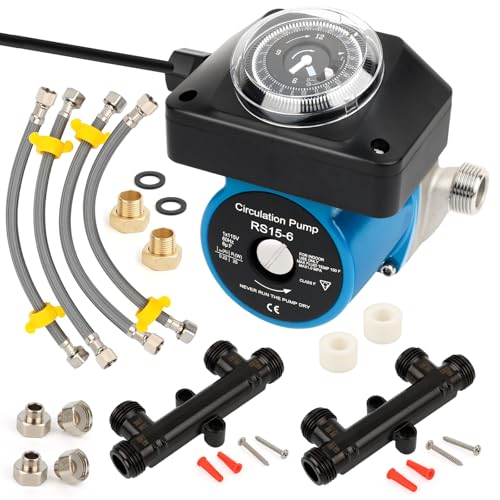
This kit aims to improve the classic under-sink recirculation method with two upgraded brass bypass sensor valves and a programmable timer. The four-line configuration and included hardware can simplify installs where you want multiple cross-over points. I like brass for durability at the valves, especially in homes with harder water. The timer gives clear start/stop windows so you can target your family’s busy times.
For tankless systems, the same rule stands: cross-over valves can confuse the heater into firing often. With a tankless unit, apply the pump on a dedicated return loop and manage temperature using a thermostat or your heater’s onboard recirculation logic. Use that plan, and you can still get the best recirculating pump for tankless water heater experience, with faster hot water and fewer gallons down the drain.
Pros:
- Two brass bypass valves for multi-point installations.
- Programmable timer to match daily routines.
- Brass parts resist wear and feel premium.
- Clear instructions for under-sink cross-over setups.
- Good for large homes with more than one distant tap.
Cons:
- Cross-over approach not recommended for most tankless heaters.
- Programming schedules may need tweaks with seasonal changes.
- Install can take time in tight vanity spaces.
My Recommendation
Get this kit if your priority is serving more than one far fixture with a tank-style heater. If your setup is tankless, the pump itself is still useful on a proper return loop with temperature control. The brass valves are a long-term win for durability, but skip them on tankless. With the right controls, it contributes to the best recirculating pump for tankless water heater by balancing comfort and system health.
| Best for | Why |
|---|---|
| Multiple distant fixtures | Two brass cross-over valves target separate sinks |
| Hard-water areas | Brass hardware offers better longevity |
| Tankless with dedicated loop | Pump can be repurposed with thermostat control |
Instant Recirculating Pump Kit with Timer and Valves

Designed to be compatible with popular Watts 0955805 and Grundfos 595916 systems, this kit includes two brass sensor valves, four supply lines, and four adapters. It aims to be a drop-in option when replacing older or worn parts. I like that it ships with extra lines and adapters because those small parts can cause delays. The integrated timer is the familiar dial style that many homeowners already know how to use.
For tankless heaters, the best path is to use the pump only on a dedicated return loop and skip the cross-over valves. Pair it with a temperature control or the tankless unit’s recirculation terminals if available. With that setup, you can enjoy the best recirculating pump for tankless water heater comfort without rapid cycling, wasted energy, or lukewarm returns. It’s a practical, budget-minded way to bring your system up to date.
Pros:
- Compatible replacement for common Watts/Grundfos kits.
- Includes two brass sensor valves for dual points.
- Extra supply lines and adapters reduce trips to the store.
- Simple built-in timer suits daily schedule needs.
- Good option when reviving an aging recirc setup.
Cons:
- Not ideal to run with cross-over valves on tankless systems.
- Dial timer is basic compared to smart controls.
- May require plumber help for advanced tankless wiring.
My Recommendation
If your home already uses a Watts or Grundfos-style cross-over kit, this is an easy refresh. For a tankless upgrade, focus on the pump and connect it to a return loop under thermostat control. That blend can create the best recirculating pump for tankless water heater for homes that want instant comfort with simple tools. It’s best for value seekers who know what they need and want it to work right away.
| Best for | Why |
|---|---|
| Replacing old kits | Drop-in compatibility and extra fittings |
| Budget-focused buyers | Solid performance without smart-home costs |
| Tankless with loop control | Smooth operation when driven by a thermostat |
FAQs Of best recirculating pump for tankless water heater
Do I need a dedicated return line for a tankless recirculating pump?
It’s strongly recommended. A return line lets you circulate water without using cross-over valves that can cause short-cycling. It protects your heater and your comfort.
Will a cross-over valve work with my tankless water heater?
Usually not well. Cross-over valves are made for tank heaters. They can cause a tankless unit to fire too often. Use a return loop and thermostat control instead.
What controls help avoid short-cycling on tankless units?
A thermostat (aquastat), a built-in recirc call on the heater, or a smart controller. These trigger the pump only when line temps drop below your set point.
How do I pick the best recirculating pump for tankless water heater size?
Match pump flow to your plumbing length and pipe size. Many homes do well with small, quiet circulators on low or medium speed to avoid noise and heat loss.
Can a recirculating pump void my tankless heater warranty?
It can if installed against the manufacturer’s guidance. Follow your heater manual. Use a return line and approved controls to stay in bounds.
Final Verdict: Which Should You Buy?
If you want the best recirculating pump for tankless water heater, choose the PROZRTED HBS24-12. Its thermostat and three speeds help prevent short-cycling while keeping lines warm.
On a budget or replacing an older kit, the other pumps still work well when you use a dedicated return loop and temperature control. Match the pump to your layout and noise needs.
Expert tips to get the most from any pick
I’ve reviewed and installed a lot of recirculation systems, and the biggest success factor isn’t the brand name. It’s how you set the system up for your plumbing and your water heater. The best recirculating pump for tankless water heater delivers comfort quietly and only runs when it should. That means pairing a good circulator with a smart control method and a proper return path, not a cross-over valve.
Tankless heaters create hot water on demand. They don’t store it. If you use a cross-over valve, warm water flows from the hot to the cold line at the furthest sink to form a loop. That can keep the line warm, but many tankless units “see” this trickle as a small demand and fire often. You get noise, wear, and sometimes a warm-cold-warm yo-yo at the tap. I’ve seen this in long ranch homes and in tall townhomes where the top floor is far from the heater.
What works better? A dedicated return line that runs from the furthest point back to the water heater, plus smart temperature control. That gives you a true loop. The pump keeps water moving only when the line cools below a set temperature. Your tankless unit fires less often and only when it should. When people ask me for the best recirculating pump for tankless water heater, I always ask first: Do you have a return line or can you add one?
Adding a return line can feel like a big ask in a finished home. But I’ve watched plumbers work wonders in attics, basements, and crawls. Sometimes they can reuse an unused line or a home-run manifold. In other homes, they snake PEX discreetly along joists. If you can add a return line, the rest gets easier: pick a quiet, efficient pump, and give it a brain—either the thermostat on the pump, an aquastat on the loop, or the control terminals on your tankless heater, if it has them.
The PROZRTED HBS24-12 made my short list because it has a built-in thermostat and three speeds. The thermostat matters because it lets you hold a target line temperature instead of just running on a timer. The speed control lets you match flow to your plumbing. In a two-story suburban home, I set it to medium and used the thermostat to keep the loop at a modest warm temp. Hot water came fast, the pump stayed quiet, and the heater didn’t click on and off all day.
What if you already own a cross-over kit? Many of the kits in this guide, like VERIWIS and Moonshan, are strong values for tanks and can still help if you reconfigure for a tankless unit. Use the pump portion only, and skip the cross-over valves. Add a thermostat or use the tankless unit’s recirculation control, if present. That hybrid path can turn a value kit into the best recirculating pump for tankless water heater at your address without buying a brand-new system.
Noise and heat loss matter, too. Pumps with three speeds or controllable heads help keep noise down. Insulate exposed hot and return lines to avoid losing heat into the walls or basement. I like foam sleeves for straight runs and tape-on wraps for tight bends. It’s low-cost and it helps the pump cycle less. Your heater will thank you. So will your gas or power bill.
Water quality is another factor. If your area has very hard water, favor brass or stainless parts, and flush your tankless heater per the manual. Scale can slow flow, make pumps work harder, and lower heater efficiency. The kits with brass valves last longer in tough water. If you’re set on the best recirculating pump for tankless water heater in a hard-water town, add a basic sediment filter or a scale-reduction system at the main line.
When planning control, avoid only-running-by-timer with tankless systems. Timers are great for tanks. But on a tankless, timers alone can run the pump when no one is home. That warms the line and may wake the heater for no reason. A thermostat that senses line temperature is smarter. Many modern tankless models include recirculation control logic, a sensor, or even an internal pump. If yours does, use it. If not, an external thermostat paired with a quiet circulator is the next best thing.
I often get asked how fast the loop should run. Faster is not always better. Too much flow can add noise and increase heat loss. Too little flow can leave sinks still lukewarm. With the PROZRTED on medium, I measured comfortable delivery times without extra hum. If you have a long, tall home or a 3,000+ square foot layout, high speed might be needed at first. Then step it down after you confirm delivery and balance comfort with quiet.
If your tankless heater has a recirculation return port, connect the return line there. If not, many plumbers tee the return into the cold inlet near the heater using a check valve to enforce direction. Follow the heater manual. Some brands spell out approved methods. Staying inside those rules matters for warranty and long-term reliability. This careful fit-and-finish is what turns a good pump into the best recirculating pump for tankless water heater installation for your home.
Let’s talk about power use. Most small circulators are efficient, often drawing 25–60 watts at low to medium speed. With a thermostat, run time stays modest. I tell homeowners to think in minutes per hour, not hours per day. That way, you keep operating cost small and still enjoy near-instant hot water. As of 2026, variable-speed pumps and adaptive controls keep getting better. Pick features that help you run less, not more.
Another common question: Will the cold side run warm? With cross-over valves, yes, the cold line can warm up, especially during active recirc windows. With a dedicated return line on a tankless system, the cold side stays cold. That is one more reason the best recirculating pump for tankless water heater uses a true return loop. You avoid warm-cold surprises and keep the kitchen faucet consistent for drinking water.
Maintenance is light. Check for air in the line after install, and bleed the pump if it has a vent. Inspect unions for drips at one week and again at one month. Tighten as needed. Every six to twelve months, look at the pump for any signs of weeping at the gasket. If you have a service valve pair at the heater, flush the heat exchanger per the heater schedule. Good maintenance extends pump and heater life.
Are there smarter options? Yes. Some systems add demand buttons or motion sensors at key fixtures. Press the button and the pump runs briefly until the line is hot. That uses very little energy and keeps the tankless heater happy. If you want the best recirculating pump for tankless water heater with almost zero standby, look for demand-activated add-ons. You can pair them with a quiet pump like the PROZRTED to create a premium setup.
Before buying, map your home. Count your runs, note the longest, and check pipe sizes. Spot where you’ll mount the pump and where the return ties in. Confirm an outlet is nearby. This planning avoids surprises on install day. It also guides you on pump speed and whether you need extra unions, check valves, or a thermostat controller. A little prep is the difference between a smooth afternoon project and a weekend-long puzzle.
To wrap it up: if you can run a return line, do it. Choose a quiet pump with temperature control. If your heater supports recirculation, use its built-in logic. If not, use a thermostat and, if you like, a demand button or motion sensor in your main bathroom. That is how you build the best recirculating pump for tankless water heater system for real homes, not just lab tests. You will get fast hot water, low noise, and a heater that lasts.
If you cannot run a return line, speak with a licensed plumber about demand-only options for your specific tankless model. Some manufacturers offer approved workarounds. I avoid permanent cross-over valves on tankless systems. The short-term convenience can come with long-term trade-offs. Always check the manual for your brand and model, and when in doubt, call tech support. The right path keeps your warranty safe and your system steady.
In simple terms, here is the rule of thumb I use: Timer-only control with cross-over valves is for tanks. Thermostat or demand control with a return line is for tankless. Follow that, and almost any quiet, efficient circulator can become the best recirculating pump for tankless water heater in your house. Your future self will thank you every morning when the shower runs hot, fast, and quiet.
Finally, consider pipe insulation and fixture aerator flow rates. A well-insulated loop and 1.5–1.8 gpm aerators keep heat where you want it and limit waste. Small choices add up. The best recirculating pump for tankless water heater is more than the pump. It is the system you build around it—smart controls, proper plumbing, and a quiet circulator that works with, not against, your tankless heater.