Considering a new water heater for your home isn’t a small decision. It affects your comfort, utility bills, and sometimes even your daily routine. Two common types people often compare are tankless water heaters and tank water heaters. Each has unique benefits and drawbacks, and the right choice depends on your needs, budget, and preferences. This guide gives you a full, clear look at both options, so you can make a confident decision without confusion.
How Tank And Tankless Water Heaters Work
Understanding the basics is the first step to making a smart choice.
Tank Water Heaters
A tank water heater stores a large amount of hot water in a tank, usually between 30 and 80 gallons. The water is heated by electricity, natural gas, oil, or propane and kept hot until you need it. When you use hot water—for a shower, washing dishes, or laundry—the water flows from the tank to your faucet or appliance. As water leaves, cold water enters the tank and is heated again.
Tankless Water Heaters
A tankless water heater (also called “on-demand”) heats water only when you need it. There’s no large storage tank. When you open a hot water tap, cold water passes through a heat exchanger that heats the water instantly. Once you close the tap, the system stops heating. Tankless models can be powered by gas or electricity.
Main Differences At A Glance
Here’s a quick look at how these two types compare:
| Feature | Tank Water Heater | Tankless Water Heater |
|---|---|---|
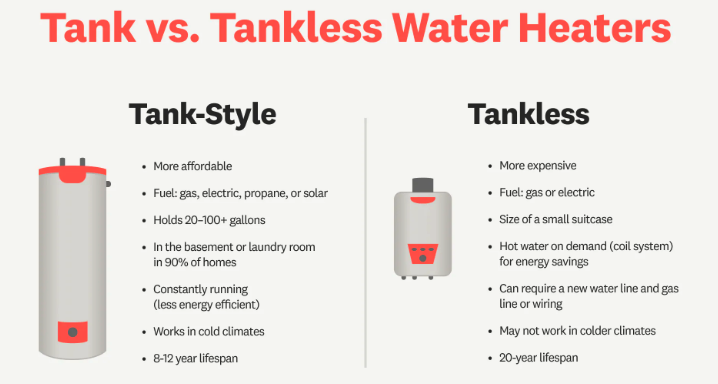
| Water Storage | Stores 30-80 gallons | No storage, heats on demand |
| Hot Water Supply | Can run out (limited by tank size) | Continuous (limited by flow rate) |
| Size | Large, needs floor space | Small, wall-mounted |
| Energy Efficiency | Lower (standby heat loss) | Higher (no standby loss) |
| Lifespan | 8-12 years | 15-20+ years |
Detailed Comparison: Tankless Vs Tank Water Heaters
1. Hot Water Availability
Tank water heaters can run out of hot water, especially if many people shower or appliances run at once. The tank needs time to reheat after emptying. This is called “recovery time.” If your tank is 50 gallons and your family uses more than that quickly, you’ll have to wait for more hot water.
Tankless water heaters never run out in the same way, since they heat water as needed. However, there is a limit to how much hot water they can produce at one time. If you try to take two showers and run the dishwasher at once, you might get lower water pressure or cooler water. This is known as the “flow rate” limit, usually measured in gallons per minute (GPM).
Non-obvious insight: In cold climates, tankless heaters may provide lower flow rates because the water entering is colder and takes more energy to heat.
2. Energy Efficiency
Tank water heaters constantly use energy to keep water hot, even when you’re not using it. This is called standby heat loss. For example, a gas tank heater typically has an energy factor (EF) of 0.58 to 0.62, meaning only about 60% of the energy is used to heat water.
Tankless water heaters are much more efficient. They only use energy when you turn on a hot tap. Their EF is often 0.82 to 0.99. Over a year, this can save you 10–34% on your water heating bill, depending on usage patterns.
Non-obvious insight: If you use very little hot water, the savings from a tankless heater are smaller because standby losses are less important.
3. Installation Costs
Tank water heaters are cheaper to buy and install. Typical prices for a new tank heater, including installation, range from $900 to $2,500 depending on tank size and fuel type.
Tankless water heaters cost more upfront. The units themselves can be $1,000 to $2,500. Installation is often $1,000 to $3,000, especially if new gas lines, venting, or electrical upgrades are needed.
Example: Replacing a gas tank heater with a tankless system might cost $3,500 total, while a new tank heater is about $1,500.
4. Operating Costs
Because tankless water heaters use less energy, you’ll usually pay less each month for utilities. The U.S. Department of Energy says the average family can save about $100 a year by switching to a tankless system.
Tank water heaters cost more to run because of standby losses.
But—if you have high hot water demand, the difference in monthly bills can be smaller. And gas is almost always cheaper than electric for heating water.
5. Lifespan And Maintenance
Tank water heaters usually last 8–12 years. Hard water and poor maintenance can shorten life. Tanks can leak or rust over time.
Tankless water heaters often last 15–20 years or more. They have fewer problems with rust and less risk of leaks, but the heat exchanger can build up scale, especially with hard water.
Maintenance: Both types need annual maintenance. With tank models, flushing the tank removes sediment. For tankless, descaling prevents mineral buildup. Skipping maintenance shortens the life of both systems.
6. Space Requirements
Tank water heaters are large and need a floor area in a basement, utility room, or garage. A 50-gallon tank is about 5 feet tall and 2 feet wide.
Tankless water heaters are much smaller, often wall-mounted. They can fit in closets, on walls, or even outside (with proper models). This frees up space in small homes or apartments.
Tip: If you need extra storage or living space, a tankless unit can help.
7. Supply During Power Outages
Gas tank water heaters can provide hot water during a power outage (if they use a pilot light, not electronic ignition). Electric tank models and all tankless models (gas or electric) need electricity to operate. If your area has frequent outages, this matters.
Example: After a storm, homes with gas tank heaters can still have hot water, but tankless models won’t work if the power is out, even if they use gas.
8. Environmental Impact
Tankless water heaters use less energy over time, so they reduce greenhouse gas emissions. They also last longer, which means fewer units in landfills.
Tank water heaters use more energy and wear out faster.
But—the higher energy use during manufacturing and installation of tankless heaters can offset some savings, especially if you replace a functioning tank heater early.
9. Water Quality And Mineral Buildup
Both types are affected by hard water, but tankless water heaters are more sensitive to mineral buildup in their narrow pipes and heat exchangers. Regular descaling is essential to maintain efficiency.
Tank water heaters collect sediment at the bottom, which can lower efficiency and reduce tank life if not flushed yearly.
Non-obvious insight: If you have very hard water, adding a water softener is a smart investment for either system.
10. Performance In Large Homes
Tank water heaters with a large enough tank can serve homes with high hot water demand better than a single tankless unit. Multiple tankless units or a “whole house” tankless system can solve this, but at higher cost.
Example: A 75-gallon tank can supply several showers and appliances at once, while a single tankless heater may struggle unless it’s sized for very high flow rates.
11. Consistency Of Water Temperature
Older tankless water heaters sometimes caused “cold water sandwiches”—brief bursts of cold water between uses. Modern models have mostly solved this, but it can still happen if water is used in quick bursts.
Tank water heaters deliver consistent temperature until the tank runs out.
12. Upfront Vs. Long-term Cost
Tank water heaters win on upfront cost—much cheaper to buy and install.
Tankless water heaters cost more at first but save money over time due to lower energy use and longer life. Most homeowners recover the extra cost in 7–10 years. If you move often, the savings may not pay off.
| Cost Type | Tank Water Heater | Tankless Water Heater |
|---|---|---|
| Purchase & Install | $900 – $2,500 | $2,000 – $4,500 |
| Annual Energy Cost | $300 – $600 | $200 – $500 |
| Maintenance/Year | $80 – $120 | $100 – $150 |
| Typical Lifespan | 8 – 12 years | 15 – 20 years |
Pros And Cons Of Each System
Looking at the main advantages and drawbacks helps clear up which is best for your situation.
Tank Water Heaters
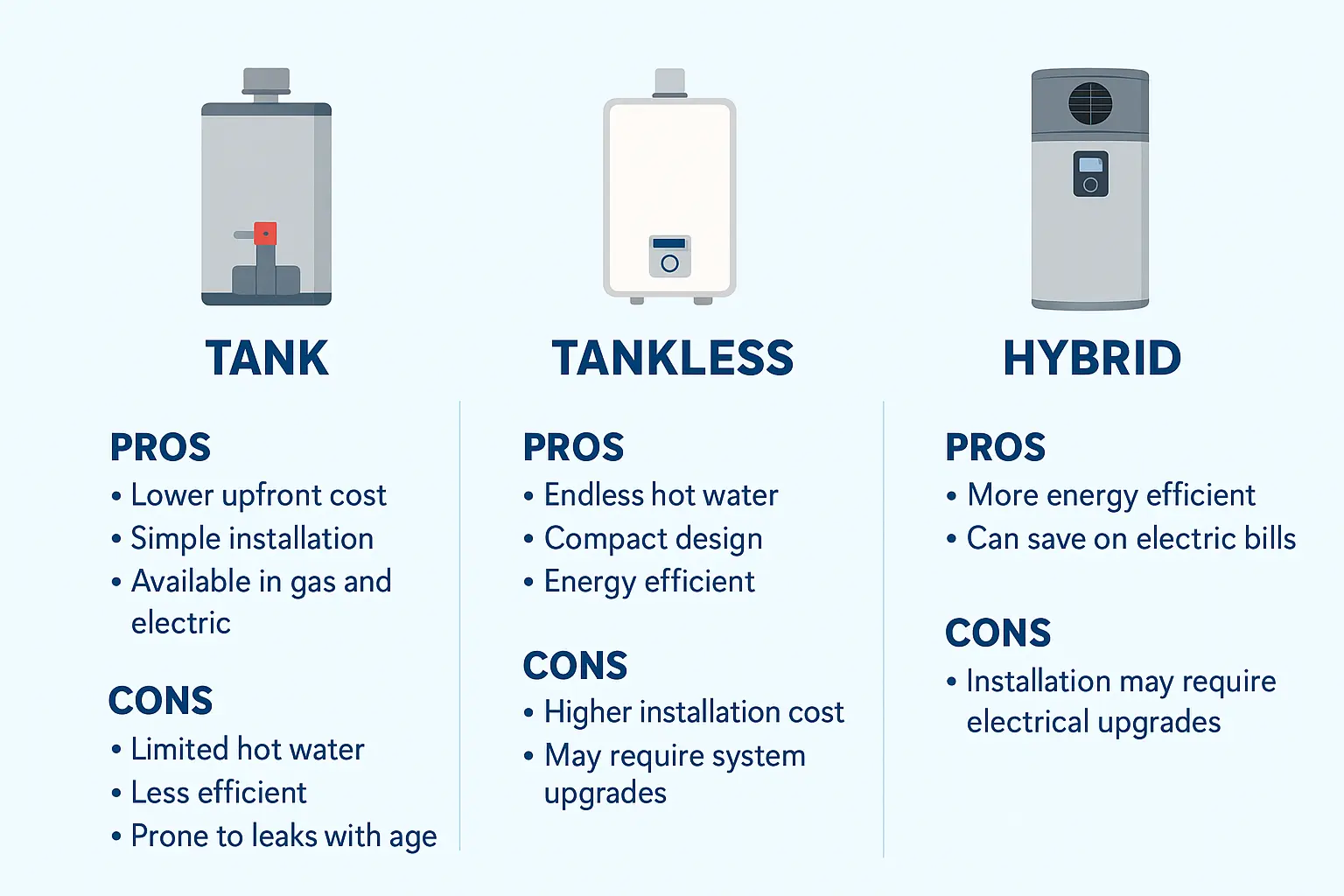
Pros:
- Lower upfront cost
- Simple installation, easy replacement
- Reliable hot water supply if sized correctly
- Can run during power outages (gas models)
Cons:
- Higher energy bills due to standby heat loss
- Runs out of hot water after heavy use
- Shorter lifespan (8–12 years)
- Takes up more space
- Risk of leaks and flooding if tank fails
Tankless Water Heaters
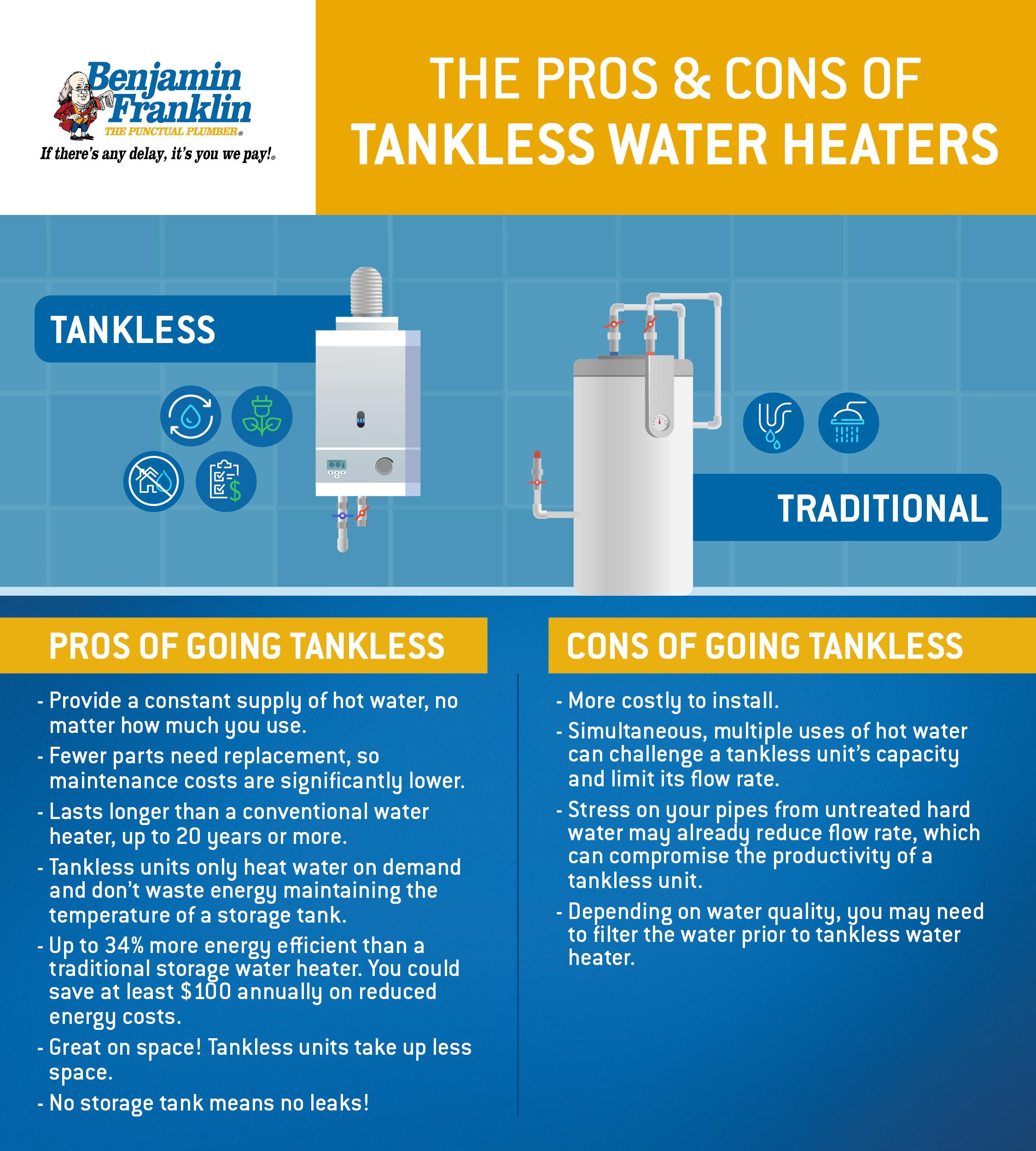
Pros:
- Endless hot water (within flow rate limits)
- High energy efficiency, lower monthly bills
- Compact size, wall-mounted
- Longer lifespan (15–20+ years)
- Lower risk of leaks
Cons:
- High upfront cost and installation complexity
- May need upgrades to gas, electric, or venting
- Flow rate limits for large households
- Requires electricity to operate, even gas models
- Sensitive to hard water buildup
Credit: www.woolyyarn.com
Key Factors To Consider When Choosing
Not every home or family will benefit the same from each type. Ask yourself these questions before making a decision.
1. How Much Hot Water Do You Use At Once?
Large families or homes with high demand may find a big tank or multiple tankless units work best.
2. What Is Your Budget?
If money is tight now, a tank system is cheaper upfront. If you want lower bills over many years, tankless may save more.
3. How Long Will You Live In The Home?
Tankless systems pay off after several years. If you plan to move soon, you might not see the full benefit.
4. Do You Have Space For A Tank?
Small homes, condos, or apartments often can’t spare the space for a large tank.
5. How Hard Is Your Water?
Very hard water means you’ll need regular maintenance on either system. Tankless units need descaling more often.
6. Do You Need Hot Water During Power Outages?
Gas tank heaters without electronic ignition can work during outages. Tankless and electric tank models cannot.
7. Environmental Impact
If reducing energy use and carbon footprint is important, tankless models use less energy and last longer.
8. Future Resale Value
Some buyers prefer tankless systems for efficiency and space, which can add value to your home.
Sizing: Get It Right The First Time
Choosing the right size is crucial for both types.
For Tank Water Heaters
The right size depends on your household’s peak hour demand—the highest amount of hot water needed in one hour. For example, a family of four may need a 50-gallon tank.
Example of peak hour demand:
- 2 showers (20 gallons)
- 1 load of laundry (7 gallons)
- 1 load of dishes (6 gallons)
- Total: 33 gallons
Add a buffer for overlapping usage.
For Tankless Water Heaters
Size based on flow rate (GPM) and desired temperature rise. If you want to run two showers (2.5 GPM each) and a dishwasher (1.5 GPM) at once, your tankless unit needs at least 6.5 GPM at your incoming water temperature.
Non-obvious insight: In cold climates, you may need a higher-capacity unit because water enters much colder.
Installation: What To Expect
Tank Water Heater Installation
Usually takes 2–4 hours for a straightforward replacement. Plumbers drain the old tank, disconnect it, and install the new one. Minimal changes needed unless switching fuel types.
Tankless Water Heater Installation
More complex, takes 4–8 hours or more. May require:
- Upgrading gas lines (for higher BTU demand)
- Upgrading electrical wiring (for electric units)
- Installing new venting or exhaust
- Possible wall mounting
Tip: Always use a licensed plumber. Poor installation can cause leaks, poor performance, or safety issues.
Maintenance: Simple Steps For Long Life
Tank Water Heaters
- Flush the tank yearly to remove sediment.
- Check the anode rod every 2–3 years.
- Test the temperature and pressure relief valve.
Tankless Water Heaters
- Descale the heat exchanger yearly (more often with hard water).
- Clean the air and water filters.
- Check for error codes and inspect venting.
Neglecting maintenance reduces lifespan and increases energy use for both types.
Cost Over Time: Real-world Example
Suppose a family of four compares a 50-gallon gas tank heater with a gas tankless unit.
- Tank heater: $1,500 installed, $450/year energy, lasts 10 years.
- Tankless heater: $3,500 installed, $325/year energy, lasts 18 years.
After 18 years:
- Tank heater: $1,500 (install) + $4,050 (energy x 9 years) + $1,800 (new heater after 10 years) + $3,600 (energy x 8 years) = $10,950
- Tankless heater: $3,500 (install) + $5,850 (energy x 18 years) = $9,350
Result: The tankless heater costs less over 18 years, but you pay more upfront.
Common Mistakes When Choosing
- Ignoring flow rate needs: Many people buy a tankless unit that’s too small, leading to lukewarm water.
- Not considering installation complexity: Tankless models sometimes need expensive upgrades.
- Skipping maintenance: Both types require annual service to last.
- Choosing the cheapest model: Low-cost units may have higher operating costs or shorter life.
- Not checking warranty: Warranties vary widely. Tankless units may offer 10–15 years on heat exchangers.
Credit: everestkitchennc.com
Real-world User Experiences
- “My tankless heater never runs out of hot water, but we had to upgrade our gas line. Worth it for our family of five.”
- “We replaced an old tank with another tank model. Easy and fast, but I wish we had more space in the basement.”
- “Tankless was great for our small condo, but the initial cost was high.”
People who need a lot of hot water at once or want to save space tend to prefer tankless. Those who want low upfront cost and easy replacement often stick with tanks.
Which Is Better For You?
If you want:
- Lowest initial cost: Choose a tank heater.
- Endless hot water and energy savings: Go tankless.
- Long-term investment: Tankless is usually better.
- Simplicity and fast install: Tank heater.
If you have a large family, consider the highest flow rate or largest tank that fits your budget and space.
Credit: www.aeroclubcomo.com
What The Experts Say
The U.S. Department of Energy recommends tankless heaters for homes with lower hot water needs or where energy savings matter. But for large families or those on a budget, tank heaters are reliable and cost-effective. For more technical comparisons, see the official U.S. Department of Energy guide.
Frequently Asked Questions
How Long Does A Tankless Water Heater Last Compared To A Tank Model?
A tankless water heater often lasts 15 to 20 years, while a typical tank water heater lasts about 8 to 12 years. Regular maintenance can extend the life of both.
Does A Tankless Water Heater Really Give You Endless Hot Water?
Yes, as long as you don’t exceed the unit’s flow rate. If you use more hot water at once than the system can produce, the temperature may drop.
Which Is Cheaper To Run: Tank Or Tankless?
Tankless water heaters are usually cheaper to run because they only heat water when needed. However, tank models may cost less if you use very little hot water, or if gas prices are low in your area.
What Kind Of Maintenance Do I Need To Do?
Both systems need yearly maintenance. Tank heaters should be flushed to remove sediment. Tankless heaters need descaling and filter cleaning. Hard water increases maintenance needs.
Can I Install A Tankless Water Heater Myself?
It’s not recommended. Tankless water heater installation often requires changes to gas, electrical, or venting systems. Professional installation is safer and usually required for warranty.
Making the right choice between a tankless water heater and a tank water heater isn’t just about cost—it’s about how you live, your home’s needs, and what matters most to you. Take time to weigh the points above, and you’ll enjoy reliable hot water for years to come.