Navien Vs Rinnai Tankless Water Heater: Which One Is Right for You?
Choosing a tankless water heater is a big decision for any homeowner or business. Hot water is something we need every day—for showers, washing dishes, and even laundry. Two names often stand out: Navien and Rinnai. Both brands have strong reputations, but which one suits your needs better? This guide will help you compare Navien and Rinnai in detail. You’ll discover their strengths, weaknesses, and what really matters when picking the perfect water heater.
If you want endless hot water, lower energy bills, and a unit that lasts for years, keep reading. By the end, you’ll know exactly which brand fits your home, budget, and expectations.
Brand Backgrounds And Reputation
Navien
Navien began in South Korea in 1978 and entered the US market in 2006. It quickly became known for high-efficiency condensing tankless water heaters. Navien focuses on innovation, eco-friendly technology, and energy savings. Many professional installers trust Navien for both home and commercial use.
Navien is part of KD Navien, a company with a long history of research and development in heating technology. Their products are designed for demanding climates, and they pay special attention to water quality issues. Over the years, Navien has earned awards for green innovation and advanced controls.
Today, you’ll find Navien units in modern homes, apartment buildings, and even some hotels—anywhere consistent, efficient hot water is important.
Rinnai
Rinnai started in Japan in 1920 and has been in the US since 1974. It’s one of the world’s largest producers of tankless water heaters. Rinnai is famous for reliability, long product life, and a wide range of models. The brand is a favorite for homeowners who want proven performance and support.
Rinnai’s global reach means their heaters are tested in many environments, from humid coastal towns to dry mountain regions. Their product line is wide, offering both entry-level and premium models. Rinnai invests heavily in training installers and building a network of service professionals, so getting support is usually easy.
Many commercial properties, such as restaurants and laundromats, choose Rinnai because of this reliability and fast service response.
How Reputation Impacts Your Choice
Both Navien and Rinnai have great reputations. But Navien is often seen as the innovator, while Rinnai is the proven classic. If you like new tech and green features, Navien stands out. If you want something tested and reliable, Rinnai may feel safer.
A brand’s reputation also affects resale value. Homes with a well-known brand heater can be more appealing to buyers. In some regions, real estate agents even mention the water heater brand in listings if it’s Navien or Rinnai.
How Tankless Water Heaters Work
Unlike traditional water heaters, tankless units heat water only when you need it. Cold water flows through a heat exchanger, and either gas or electricity heats it instantly. There’s no storage tank, so you avoid standby heat loss and never run out of hot water—as long as the unit matches your demand.
This on-demand design means you don’t waste energy keeping a large tank of water hot 24/7. Instead, the unit senses when you open a faucet and fires up immediately. Once you close the faucet, it stops heating. This “smart” approach is why tankless units can save so much energy over time.
Key Benefits
- Endless hot water (no waiting for a tank to refill)
- Lower energy bills (no reheating stored water)
- Smaller size (saves space)
- Longer lifespan (up to 20 years or more with care)
The smaller size makes tankless heaters great for condos, apartments, or homes where storage is limited. You can mount them on a wall—even in a closet or utility room. And because there’s no tank to rust or leak, you avoid many of the problems that come with old tank heaters.
Common Tankless Water Heater Concerns
- Higher upfront cost than tank models
- May need upgrades to gas lines or venting
- Flow rate limits (can you run two showers and a dishwasher at once?)
One thing some people don’t expect: there can be a short delay (a few seconds) before hot water arrives, especially if the unit is far from the faucet. Recirculation pumps (built into some models) help solve this, but it’s still a point to consider when planning your system.
Head-to-head: Navien Vs Rinnai
When comparing Navien and Rinnai, it helps to look at several key categories. These include performance, energy efficiency, durability, features, installation, and cost.
Performance And Flow Rate
You want a water heater that keeps up with your family’s needs. The key measure is flow rate, usually in gallons per minute (GPM). Higher GPM means more hot water for multiple uses at once.
| Model | Max Flow Rate (GPM) | Best For |
|---|---|---|
| Navien NPE-240A2 | 11.2 | Large homes, multiple showers |
| Rinnai RU199iN | 9.8 | Medium to large homes |
| Navien NPE-180A2 | 8.4 | Small to medium homes |
| Rinnai V75IN | 7.5 | Small homes, apartments |
Navien models often offer slightly higher flow rates for the price, which is useful for bigger families. Rinnai still provides strong flow, but some entry-level models have lower GPM.
Non-obvious insight: Flow rates drop if you have very cold incoming water (like in northern states). Always ask your installer for the “real-world” GPM—not just what’s on the box.
Also, remember that advertised GPM is at a set temperature rise (usually 35°F). If you need hotter water, the flow rate will be lower. For example, if you want a higher temperature for a deep soak tub, both brands’ units will provide less GPM.
Energy Efficiency
Both brands focus on high efficiency, using condensing technology to get more heat from the fuel. They measure efficiency by Uniform Energy Factor (UEF) or Energy Factor (EF). The higher the number, the less energy is wasted.
| Model | Efficiency Rating (UEF/EF) | Energy Star Certified |
|---|---|---|
| Navien NPE-240A2 | 0.96 UEF | Yes |
| Rinnai RU199iN | 0.93 UEF | Yes |
| Navien NPE-150S2 | 0.95 UEF | Yes |
| Rinnai RL94eN | 0.82 UEF | No |
Navien often leads in efficiency, especially for larger models. This means more savings on your energy bill. Rinnai units are still highly efficient but sometimes rate a bit lower on paper.
Extra detail: Some utility companies look for Energy Star certification when offering rebates. Navien’s higher UEF can qualify you for bigger savings in some states, making the price difference smaller.
Durability And Lifespan
Rinnai is famous for long-lasting products. Many Rinnai heaters work for 20 years or more with proper care. Navien units are also durable but use more advanced parts, which can be harder to find or replace if something breaks.
Non-obvious insight: Hard water (with lots of minerals) can wear out tankless heaters faster. Rinnai’s heat exchangers are made of thicker copper, while Navien’s are stainless steel. Stainless steel resists corrosion better, but copper can transfer heat more quickly.
In real-world use, both brands perform well, but regular maintenance is key. If you live in an area with hard water, consider adding a water softener or pre-filter to protect your investment. Many homeowners are surprised to learn that skipping maintenance can void the warranty, even if the heater itself is fine.
Features And Technology
Both brands include smart features, but their approach is a little different.
Navien Standout Features
- Built-in recirculation pump (in “A” models): Reduces wait time for hot water at faucets
- Advanced control panel: Easy to adjust temperature and view error codes
- Wi-Fi module (optional): Control with your phone, get maintenance alerts
- Dual stainless steel heat exchangers: Last longer, resist corrosion
Navien’s smart diagnostics and error codes make troubleshooting easier for technicians. Some models even let you set schedules for recirculation or monitor energy use, which helps you optimize performance.
Rinnai Standout Features
- Wi-Fi Ready (with Control-R app): Remotely monitor and adjust settings
- Circ-Logic: Customizes recirculation schedules for your routine
- Scale Detection: Alerts you if minerals build up inside
- ThermaCirc360 (in select models): Built-in recirculation for faster hot water
Rinnai’s app lets you see the system’s status, adjust temperature, and get alerts if something goes wrong. Circ-Logic is especially helpful if your family follows a set routine, like morning showers or evening baths.
Practical tip: If you live in a big house or hate waiting for hot water, a built-in recirculation pump is a game changer. Navien includes this in many models; Rinnai offers it in select ones.
Installation And Maintenance
Tankless water heaters are more complex to install than traditional tanks. You may need upgrades to your gas line, venting, or even your home’s water pipes.
Navien Installation
Navien heaters are a bit heavier and larger. They often require PVC venting (cheaper and easier to install than metal venting). The built-in recirculation pump can save on extra plumbing work.
Navien’s design sometimes lets installers use existing venting, but always check local codes. If you’re replacing an old tank heater, plan for a longer installation (and possibly higher cost).
Rinnai Installation
Rinnai models are lighter and have more flexible venting options (PVC or concentric venting). They are known for being “installer-friendly,” so you may pay less for labor.
Rinnai provides detailed installation manuals and training videos, which help even less experienced plumbers get the job done right. This can lower the risk of mistakes and speed up installation.
Non-obvious insight: Not all installers are comfortable with both brands. Navien’s advanced features can confuse inexperienced plumbers. Always choose a certified installer with experience for your chosen brand.
Maintenance
Both brands need annual flushing to remove minerals (especially if you have hard water). Rinnai’s “scale detection” can help remind you, but Navien’s stainless heat exchangers resist buildup better.
Maintenance usually takes about an hour and is not expensive, but skipping it can lead to expensive repairs later. Some homeowners install isolation valves to make flushing easier—a small extra cost that saves time every year.
Cost Comparison
The total cost includes the unit price, installation, and future maintenance.
| Brand | Typical Unit Price | Installation Cost | Expected Maintenance (Annual) |
|---|---|---|---|
| Navien | $1,100 – $2,500 | $1,200 – $2,000 | $120 – $200 |
| Rinnai | $900 – $2,300 | $1,000 – $1,800 | $100 – $180 |
Navien models tend to cost more upfront, especially with the recirculation feature. Rinnai units are a bit less expensive and may be cheaper to install. Over time, the energy savings from a higher efficiency model (like Navien) can even out the higher purchase price.
Tip: Look for local utility rebates—many states offer incentives for high-efficiency models, which can reduce the price of both brands.
Extra detail: If you plan to stay in your home for many years, the higher efficiency of Navien could save you hundreds of dollars in energy bills over the lifetime of the heater. But if you’re planning to move soon, the lower upfront cost of Rinnai may make more sense.
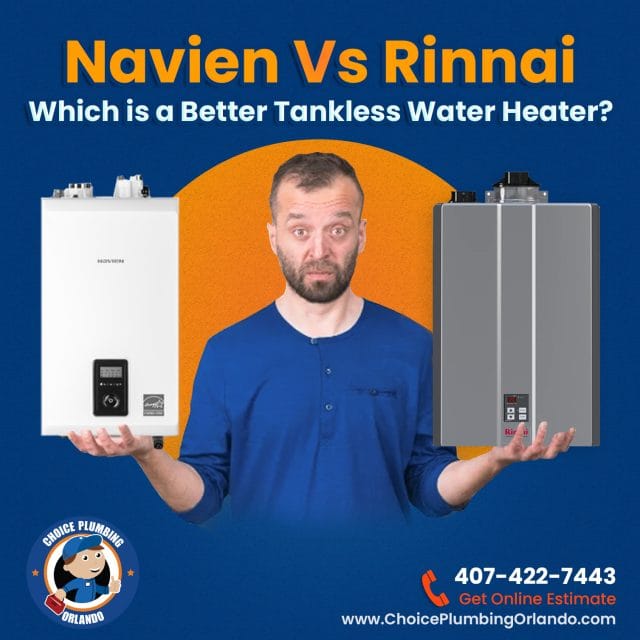
Credit: choiceplumbingorlando.com
Model Lineups Compared
Both Navien and Rinnai offer several models for different home sizes and needs. Here are some top options for each:
Popular Navien Models
- NPE-240A2: Top-of-the-line, 11.2 GPM, built-in recirculation, ultra-high efficiency
- NPE-210A2: 10.1 GPM, condensing, recirculation pump
- NPE-180A2: 8.4 GPM, smaller homes, still has recirculation
- NPN-199E: Non-condensing, 9.3 GPM, outdoor installation
- NPE-150S2: 6.6 GPM, lower price, high efficiency
Navien’s “A” series models are popular for families who want instant hot water at every tap. The “S” series skips recirculation for a lower price.
Popular Rinnai Models
- RU199iN: 9.8 GPM, condensing, Wi-Fi ready, recirculation available
- RUR199iN: 11 GPM, top efficiency, ThermaCirc360 recirculation
- RL94eN: 9.4 GPM, non-condensing, outdoor
- V94IN: 9.8 GPM, budget option, indoor
- V65IN: 6.5 GPM, small homes, lowest cost
Rinnai’s “RU” and “RUR” series are the top choices for busy homes. The “V” series is a great entry-level option for smaller spaces.
Pro tip: Always size your water heater for the busiest time of day (for example, two showers and a dishwasher at once). Undersizing leads to cold showers!
Warranty And Support
Navien
- Heat exchanger: 15 years (residential), 10 years (commercial)
- Other parts: 5 years
- Labor: 1 year
Navien’s long heat exchanger warranty shows confidence in their stainless steel design. Support is mostly via phone or online portal.
Rinnai
- Heat exchanger: 12 years (residential), 5 years (commercial)
- Other parts: 5 years
- Labor: 1 year
Rinnai offers strong warranties and has a large network of service professionals in North America.
Real-world insight: Warranty claims are easier if you use a certified installer and register your unit online. Unregistered or DIY installs can void the warranty for both brands.
Navien’s support is often praised for quick responses, but parts may take longer to arrive in some areas. Rinnai’s larger service network can mean faster repairs in cities and suburbs.

Credit: www.youtube.com
Noise, Size, And Location
Noise
Both Navien and Rinnai are very quiet compared to older tank heaters. Navien’s recirculation pump can be heard when running, but it’s not loud.
If your unit is installed near a bedroom or living space, you’ll hardly notice it—just a soft fan or pump sound. For sensitive sleepers, ask your installer about sound-dampening options.
Size
- Navien: Slightly larger, especially condensing models with recirculation pump
- Rinnai: More compact, fits in tighter spaces
Navien’s extra features (like dual heat exchangers or recirculation) add size but are usually not an issue unless space is very limited.
Indoor Vs Outdoor Models
Both brands offer indoor and outdoor units. Outdoor models save space inside but need freeze protection. Rinnai’s outdoor units are especially popular in warmer climates.
If you live in an area with freezing winters, your installer may recommend a backup heater or extra insulation for outdoor units. Always follow the manufacturer’s guidelines to avoid costly freeze damage.
Environmental Impact
If you care about the environment, both brands are good choices. Their condensing models use less energy and release fewer greenhouse gases.
- Navien: Focuses on ultra-high efficiency and low emissions
- Rinnai: Many models are Energy Star certified, and the brand has a strong recycling program
Little-known fact: Condensing models (from both brands) can use cheaper PVC venting, which is easier to recycle and install.
Both companies are working to reduce emissions in manufacturing. Rinnai recycles old heaters and packaging, while Navien’s focus on efficiency means lower carbon footprints over time.

Credit: www.reddit.com
Common Mistakes When Choosing
- Undersizing the unit: Not enough GPM means cold showers when multiple taps are used.
- Skipping annual maintenance: Mineral buildup can ruin the heater early.
- Ignoring venting needs: Wrong vent type can cause dangerous exhaust leaks.
- DIY installation: Can void warranties and lead to safety issues.
- Not checking water quality: Hard water can shorten lifespan without a filter or softener.
Another common mistake is not budgeting for installation extras, such as water softeners, recirculation lines, or upgraded gas pipes. These add to the initial cost but are sometimes necessary for proper performance.
Which Brand Is Best For You?
There is no one-size-fits-all answer, but here’s a quick summary:
- Choose Navien if: You want the highest efficiency, built-in recirculation, and don’t mind a higher upfront cost. Good for new homes or major remodels.
- Choose Rinnai if: You want proven reliability, lower price, and easy installation. Good for replacing old units or upgrading with less hassle.
Experience-based tip: Ask local plumbers which brand they prefer to service. A great heater is only as good as the support available in your area.
If you want to future-proof your home with smart features and energy savings, Navien is hard to beat. If you need something simple, robust, and widely supported, Rinnai is a trusted choice.
Real-world Examples
Scenario 1: Large Family, Busy Mornings
The Navien NPE-240A2 handles three showers, laundry, and a dishwasher at once—thanks to its high GPM and recirculation. Energy bills are lower, but the upfront cost is higher.
This family enjoys nearly instant hot water in every bathroom, and the advanced app lets them monitor usage and get alerts for maintenance. Over a year, they notice their gas bills drop compared to their old tank heater.
Scenario 2: Small Home, Budget Focus
The Rinnai V65IN fits in a closet, costs less, and is easy to install. It covers one shower and a kitchen tap, but not much more.
The owner loves the simple controls and quiet operation. They did not need to upgrade gas lines, which kept installation costs low. Maintenance reminders from the app make it easy to keep the unit running well.
Scenario 3: Cold Climate
Both Navien and Rinnai perform well, but Navien’s stainless steel heat exchanger resists freezing and corrosion a bit better.
One homeowner in Minnesota chose Rinnai for the strong local support and added extra pipe insulation. Another picked Navien for the corrosion resistance and built-in recirculation to prevent pipes from freezing.
Final Thoughts
Choosing between Navien and Rinnai comes down to your needs, budget, and local support. Navien leads in efficiency and features, while Rinnai wins for reliability and simple installation. Both brands offer excellent tankless water heaters that will save energy and give you hot water on demand.
Before you buy, talk with a certified installer, ask about warranties, and check for rebates. Either choice is a long-term investment in comfort and energy savings.
For more technical details about tankless water heaters, check the US Department of Energy guide.
Frequently Asked Questions
What Size Tankless Water Heater Do I Need For My Home?
The size depends on how many hot water fixtures you’ll use at the same time. Add up the flow rates (GPM) for showers, sinks, and appliances you want to run together. Choose a model with at least that GPM. For example, two showers (2.
5 GPM each) and a dishwasher (1. 5 GPM) need at least 6. 5 GPM.
If you have a large bathtub or multiple bathrooms, consider adding extra GPM for comfort. Also, factor in the temperature of your incoming water—colder climates require more power to reach the same temperature, which lowers total GPM.
How Long Do Navien And Rinnai Tankless Water Heaters Last?
With proper maintenance, both brands can last 15-20 years or more. Rinnai has a long history of units lasting over 20 years. Navien’s stainless steel heat exchangers resist corrosion and often last as long or longer, especially in homes with hard water.
Regular maintenance, such as flushing and checking for leaks, is the biggest factor in lifespan. If you live in a hard water area, installing a pre-filter or water softener can add years to your heater’s life.
Are Navien Or Rinnai Tankless Water Heaters Hard To Maintain?
Both brands need annual maintenance, mainly flushing out minerals. Rinnai includes scale detection in some models to help remind you. Navien’s stainless steel heat exchanger is more resistant to scale, but you still need to flush it. Most people hire a plumber once a year for this job.
Maintenance is usually simple if you have isolation valves installed. Some users learn to flush the system themselves, but most prefer to hire a pro for peace of mind.
Can I Install A Tankless Water Heater Myself?
It’s not recommended. Tankless heaters need proper gas line sizing, venting, and electrical work. DIY installation may void the warranty and can be dangerous. Always hire a certified installer experienced with your chosen brand.
Certified installers also help you register the unit for warranty coverage and make sure everything meets local building codes. This saves you headaches and possible fines later.
Which Is Better For Cold Climates: Navien Or Rinnai?
Both brands work well in cold climates, but Navien’s stainless steel heat exchanger is less likely to freeze or corrode. Rinnai offers freeze protection features too. Ask your installer about insulation and freeze protection if you live in a cold area.
Some models allow you to add external freeze protection or use internal recirculation to keep water moving. Always discuss your climate needs with your installer.
Choosing between Navien and Rinnai is easier when you know what matters most for your home. If you focus on the right size, local support, and regular maintenance, you’ll enjoy reliable hot water for years—no matter which brand you choose.