
Every year, thousands of students in England, Wales, and Northern Ireland await their GCSE results. These grades do more than fill a report card—they open or close doors to sixth form colleges, apprenticeships, and even university courses down the road. But with nine subjects, numbers instead of letters, and different exam boards, it’s easy to feel lost. That’s where a GCSE average grade calculator can make life simpler.
This article explores everything you need to know about calculating your average GCSE grade. You’ll learn why it matters, how to do it manually, how online calculators work, and why universities and employers care. We’ll break down the grading system, give you common pitfalls to avoid, and answer key questions students and parents ask.
By the end, you’ll know how to calculate, check, and understand your average GCSE grade with confidence.
What Is A Gcse Average Grade Calculator?
A GCSE average grade calculator is a tool that helps you find the mean grade across all your GCSE subjects. Instead of looking at each grade separately, the calculator combines them and gives you one number. This average is useful for applying to further education, comparing your performance, and understanding your overall achievement.
Most calculators ask you to enter each subject’s grade. Some also let you include the subject’s weighting if certain subjects count more than others (for example, double science). The calculator then converts each grade into a number, adds them together, and divides by the number of subjects.
Why Does Your Average Gcse Grade Matter?
Many students wonder, “Why should I care about my average?” Here’s why it’s important:
- Sixth Forms and Colleges: Many post-16 providers set minimum average grade requirements.
- University Admissions: Some university courses look at your GCSE profile, especially for competitive fields.
- Apprenticeships: Employers sometimes use average grades to shortlist candidates.
- Self-Reflection: An average gives you a clearer picture of your overall strengths and weaknesses.
For example, if you have a mix of high and low grades, the average shows your general performance, not just the extremes.
Understanding The Gcse Grading System
Before you can calculate an average, you need to know how the grades work. The current system uses numbers instead of letters. Here’s a quick breakdown:
| Grade | Old Equivalent | Description |
|---|---|---|
| 9 | A* | Top mark, higher than old A* |
| 8 | A* | Just below the new 9 |
| 7 | A | Strong pass |
| 6 | B | Above average |
| 5 | High C/Low B | Strong pass |
| 4 | C | Standard pass |
| 3 | D | Below pass |
| 2 | E | Poor |
| 1 | F/G | Lowest |
| U | U | Unclassified (fail) |
Non-obvious insight: Grade 9 isn’t just “A*”—it’s set above the old A*, so it’s even harder to get. Not all schools award grade 9, especially in less common subjects.
How The Calculator Works: Step By Step
To use a GCSE average grade calculator, you need to know how each grade is turned into a number. Most calculators use the following scale:
- 9 = 9 points
- 8 = 8 points
- 7 = 7 points
- 6 = 6 points
- 5 = 5 points
- 4 = 4 points
- 3 = 3 points
- 2 = 2 points
- 1 = 1 point
- U = 0 points
Let’s walk through the process:
- Write down each subject and grade.
- Convert each grade to a number using the scale above.
- Add the numbers together.
- Divide by the number of subjects.
If you take double or triple science, count each as two or three subjects, not just one.
Example Calculation
Suppose you took these subjects:
- English Language: 6
- English Literature: 5
- Maths: 7
- Combined Science: 6, 5
- History: 8
- Geography: 6
- French: 4
First, convert the grades:
- English Language: 6
- English Literature: 5
- Maths: 7
- Science: 6 + 5 = 11
- History: 8
- Geography: 6
- French: 4
Total points: 6 + 5 + 7 + 6 + 5 + 8 + 6 + 4 = 47
Subjects: English Language, English Literature, Maths, Science (2), History, Geography, French = 8
Average: 47 ÷ 8 = 5.875
So, the GCSE average grade is 5.88 (rounded to two decimal places).
Non-obvious insight: If you count double or triple science as one subject, you’ll get a misleading average. Always count each grade separately.
When Should You Calculate Your Average?
You might think you only need your average for university. In reality, there are several key times to use a calculator:
- After Mock Exams: To check your progress and set targets.
- When Applying to Sixth Form: Some require a minimum average (e.g., 5.5).
- For Apprenticeships: Many schemes look for an average above 5.
- When Comparing to National Averages: In 2023, the average pass rate for grade 4 was about 70% (BBC News).
Manual Calculation Vs. Online Calculator
You can calculate your average by hand or use a website. Here’s how they compare:
| Method | Pros | Cons |
|---|---|---|
| Manual | Builds understanding, no internet needed, flexible for unusual cases | Time-consuming, risk of mistakes, harder with many subjects |
| Online Calculator | Quick, error-free, easy to share or print results | Depends on internet, some don’t handle special cases (e.g., missing grades) |
Practical tip: If you have any grades missing or special cases (like resits), double-check how the calculator handles these.
What If You Have Different Numbers Of Subjects?
Most students take 8–10 GCSEs, but some take more or less. Here’s how it affects your average:
- Taking more subjects means one bad grade has less impact.
- Fewer subjects: Each grade makes a bigger difference.
- Special subjects: Some schools offer extra GCSEs like Further Maths or Latin.
Experience-based tip: If you take a subject outside school (like a language at a weekend school), ask your college if you should include it in your average.
How Are Double And Triple Awards Counted?
Double Award Science gives you two GCSEs, usually with two grades (e.g., 6-5). Triple Science gives you three grades (Biology, Chemistry, Physics).
- For double award: Enter both grades separately.
- For triple award: Enter all three grades.
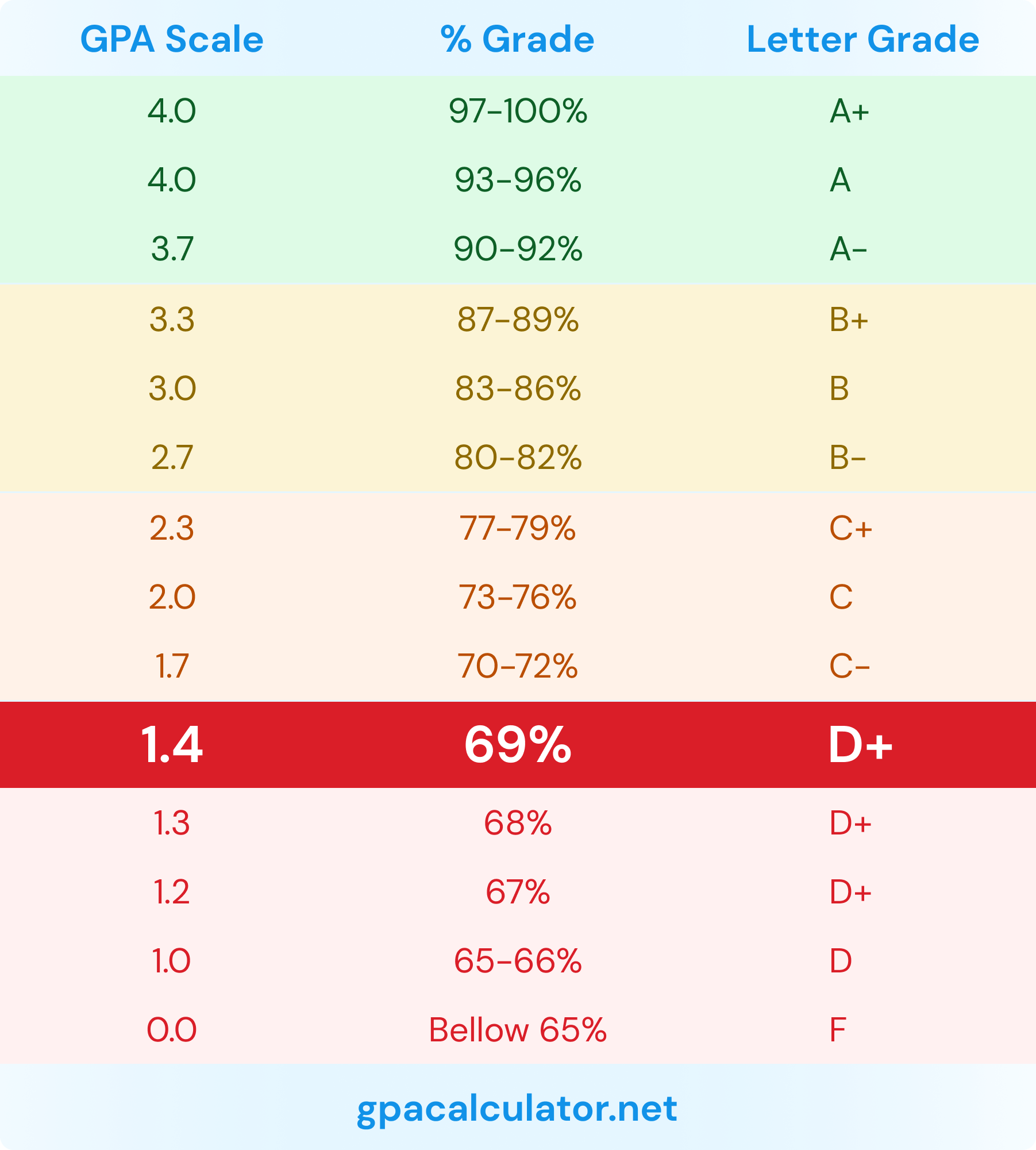
If you only enter one number for double science, your average will be too high or too low.
Credit: gpacalculator.net
Weighting And Core Subjects
Some calculators let you “weight” core subjects like Maths and English. This means they count for more in your average.
- Weighted average: Maths and English might be counted twice.
- Unweighted average: All subjects are counted once.
Always check what the sixth form or college wants. Most use the unweighted method unless stated.
Non-obvious insight: Some top sixth forms count only your best eight grades, while others include all subjects. Always check their policy before applying.
Interpreting Your Average Grade
Once you know your average, what does it mean? Here’s a rough guide:
- 7–9: Excellent (competitive for top courses)
- 5–6.9: Good (meets most requirements)
- 4–4.9: Satisfactory (passes, but may limit choices)
- Below 4: At risk (may need to resit English or Maths)
But averages don’t tell the full story. Two students with a 6 average might have very different subject strengths.
Case Study
- Student A: 8, 8, 8, 8, 2, 2, 2, 2 (average = 5)
- Student B: 5, 5, 5, 5, 5, 5, 5, 5 (average = 5)
Student A is strong in some areas, weak in others. Student B is consistent. Some sixth forms prefer consistency.
Common Mistakes When Calculating Your Average
- Not counting double/triple science correctly
- Forgetting to include all subjects
- Using old letter grades without converting
- Not rounding the final result
- Including BTECs or non-GCSEs (unless the college allows)
Tip: Always check the guidelines for the place you’re applying to.
How To Use An Online Gcse Average Grade Calculator
Most calculators are simple:
- Enter each subject and grade.
- Click “Calculate”.
- See your average instantly.
Some calculators let you:
- Add or remove subjects.
- Choose between weighted and unweighted.
- Print your results.
For accuracy, always double-check your grades before entering them.
What If You Have Missing Grades Or Special Cases?
- Resits: Use your best grade for each subject.
- Missing grades: Some calculators let you leave blanks. Others count as zero.
- Non-GCSEs: Only include if specifically allowed.
If you are unsure, ask your college or future employer.
How Schools And Colleges Use Average Grades
Sixth forms and colleges use the average grade to:
- Set entry requirements (e.g., “minimum 5.5 average”)
- Decide which subjects you can take (e.g., “Maths A Level: 7 in Maths”)
- Compare applicants
Some schools publish their average grades to show performance compared to national statistics.
Tips To Improve Your Average Gcse Grade
If you’re still studying, you can take steps to boost your average:
- Focus on weak areas: Even one grade higher can raise your average.
- Don’t ignore core subjects: Maths and English matter most.
- Practice past papers: These reveal where you lose marks.
- Ask for feedback: Teachers can help spot patterns in your mistakes.
Non-obvious tip: Improving from a 4 to a 5 in one subject can have a bigger impact than from 7 to 8, especially if it means moving from a “standard pass” to a “strong pass”.
How Employers And Universities View Your Average
Most employers and universities look at:
- Maths and English: These are always important.
- Overall average: Shows consistency and effort.
- Individual strengths: For courses like science, your science grades may matter more.
Some competitive universities (like Oxford or Cambridge) check for a high average and a strong set of grades across all subjects.
Practical example: For medicine, many universities want at least a 7 in all sciences and maths, and a high average.
Advanced Calculations: Best 8 Subjects
Some calculators and schools focus on your best 8 GCSEs. This means only your top grades are counted.
- Add up your top 8 grades.
- Divide by 8.
This method is often used for sixth form applications where students have many GCSEs.
Caution: If you have fewer than eight subjects, your average is based on all.
Should You Include Btecs Or Other Qualifications?
Most calculators are designed for GCSEs only. Some sixth forms allow you to include BTEC Level 2 or equivalent qualifications, but not all do.
- Check the policy: Never assume you can include a BTEC.
- If allowed: Convert your result to the GCSE scale (e.g., Merit = 6).
What If You Took Some Gcses Early?
If you passed a GCSE in Year 10 or earlier, include the grade unless told otherwise. Some calculators let you enter the year taken; others do not.
How Do Different Schools Calculate Averages?
Not all schools use the same rules. Here are common variations:
- All subjects counted: Most common.
- Best 8 only: Used by some competitive colleges.
- Weighted for core subjects: Some count English and Maths twice.
- Exclusions: Some ignore “non-traditional” subjects.
Always check with your target school or college before submitting your average.

Credit: help.cem.org
Sample Average Calculations For Different Scenarios
Scenario 1: Standard Student
- Subjects: 9
- Grades: 7, 6, 7, 6, 5, 5, 4, 6, 5
- Total: 51
- Average: 51 ÷ 9 = 5.67
Scenario 2: Double Science
- Subjects: English, Maths, Science (double), History, Spanish, Art = 7 grades
- Grades: 6, 5, 5, 4, 5, 4, 3
- Total: 32
- Average: 32 ÷ 7 = 4.57
Scenario 3: Best 8 Subjects
- Grades: 9, 8, 8, 7, 7, 6, 6, 6, 5, 4
- Best 8: 9 + 8 + 8 + 7 + 7 + 6 + 6 + 6 = 57
- Average: 57 ÷ 8 = 7.13
The Role Of Average Grade In National Statistics
National averages shift each year. For example, in 2023:
- About 70% of entries were grade 4 or above.
- Grade inflation from the pandemic is returning to normal.
Comparing your average to national data gives you context, but remember, universities and employers often look at individual grades too.
Credit: ostado.uk
Useful Features In Online Calculators
Some advanced calculators offer:
- Subject weighting
- Best 8/All subjects
- Printable reports
- Comparison to national average
Choose a calculator that matches your needs and check its instructions.
How To Choose The Right Calculator
Look for:
- Updated for new grades (1–9)
- Handles double/triple science
- Option for best 8 calculation
- Clear instructions
Avoid calculators that use the old A*–G system unless you took your exams before 2017.
Data Security And Privacy
When using online calculators, be careful with personal data. Most don’t ask for names, but avoid entering extra details unless the site is secure.
How To Explain Your Average To Others
When applying for a sixth form, apprenticeship, or job, be clear about:
- How you calculated your average
- Which subjects were included
- If you used weighted or best 8 method
This avoids confusion and shows you understand the process.
Final Thoughts
Calculating your GCSE average grade is more than just a numbers game. It gives you a realistic picture of your academic profile and helps you plan your next steps. Whether you’re aiming for a top sixth form, a specific apprenticeship, or just want to track your progress, knowing your average is crucial. Remember to include all relevant subjects, use the correct method, and double-check the requirements of your chosen path.
By understanding how the calculator works—and avoiding common mistakes—you can use your average as a tool, not just a statistic. And if in doubt, ask your teachers or admissions team for guidance.
Frequently Asked Questions
How Do I Calculate My Gcse Average If I Have A Mix Of Old And New Grades?
Convert old letter grades to the new 1–9 scale using an official conversion chart. For example, A* = 8 or 9, A = 7, B = 6, etc. Then add all grades together and divide by the number of subjects.
Should I Include Resits When Calculating My Average Grade?
Use your highest grade for each subject, even if you resat. Most schools and colleges only count the best attempt, not the first.
Can I Include Btec Or Vocational Qualifications In My Average?
Only if the sixth form or employer says so. If allowed, convert the qualification to the equivalent GCSE grade (e. g. , Merit = 6), but always check their policy first.
What Happens If I Have A “u” Grade In One Subject?
A “U” counts as zero points and lowers your average. If possible, consider resitting to improve your average and open up more options.
Do Universities Care More About Average Or Individual Gcse Grades?
It depends on the university and course. Some look at the average, but most want strong individual grades in key subjects like Maths, English, and Science.
By following this guide, you’ll be able to calculate, check, and use your GCSE average grade with confidence—helping you make informed choices for your future.